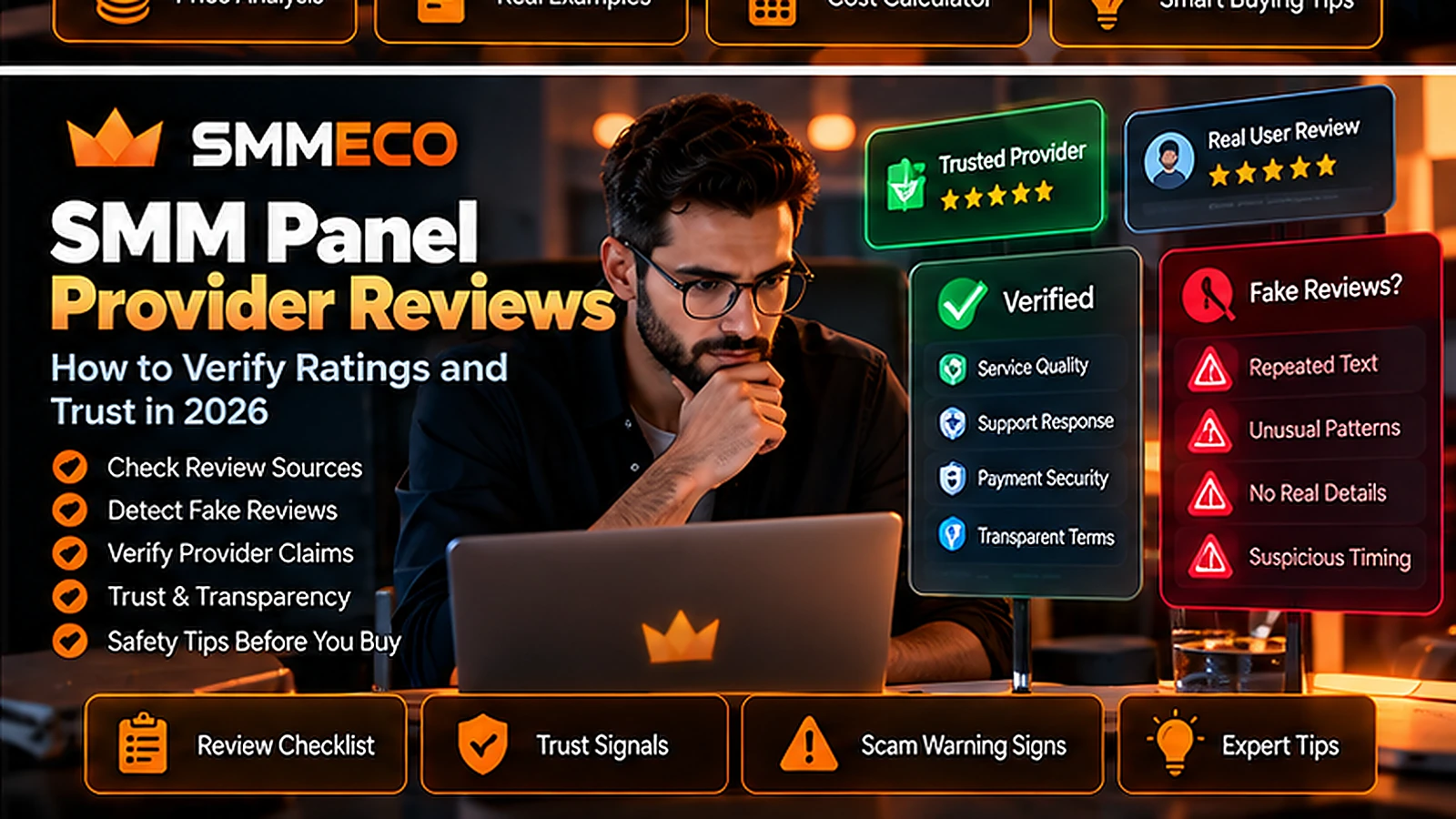
SMM Panel Provider Reviews: How to Verify Ratings and Trust in 2026
Before choosing an SMM panel provider, many customers search for reviews.
A website might advertise a high satisfaction rating, display customer testimonials, or describe itself as the most trusted SMM panel in the market.
These claims can appear reassuring, especially when the provider also advertises attractive prices and extensive service categories.
But how can you determine whether the information is reliable?
SMM panel provider reviews are most useful when you examine the source, timing, detail, authenticity, and relevance of the feedback rather than relying on an overall star rating.
A collection of positive comments is not necessarily proof of consistent service performance.
Likewise, a single negative review does not automatically prove that a business is dishonest.
This guide explains how to evaluate SMM panel reviews, identify suspicious patterns, investigate provider claims, and make more informed purchasing decisions.
It also explains why transparency matters for platforms such as SMMECO and other businesses operating in the SMM industry.
Can You Trust SMM Panel Provider Reviews?
SMM panel reviews can provide useful information, but their reliability depends on whether they describe genuine experiences and can be evaluated in context.
Reviews may discuss account funding, support interactions, order accuracy, refund disputes, or general service conditions.
However, reviews can also be misleading.
Some are promotional messages rather than independent customer experiences.
Others may be outdated or lack enough information to establish what occurred.
A negative review may also reflect a misunderstanding of published terms rather than evidence of deliberate misconduct.
Quick Answer: To evaluate SMM panel reviews, check the review platform, look for specific details, compare positive and negative experiences, inspect dates, investigate repeated wording, and verify important claims against the provider's published policies. Do not treat star ratings as proof of service quality.
Why SMM Panel Reviews Require Careful Evaluation
SMM providers operate in a market where customers may rely heavily on advertised service outcomes and account-based payment systems.
A customer often needs to add funds before using the platform.
The provider may also depend on upstream suppliers whose operations are not visible to the customer.
This makes transparency particularly important.
A review may describe one transaction without representing the provider's wider performance.
Furthermore, two customers using the same website may select completely different services.
A positive experience with one category does not guarantee identical conditions for every other listing.
The most useful review helps explain what happened, not merely whether the reviewer liked the brand.
1. Check Where the Reviews Are Published
Start by identifying the source.
A testimonial published on a provider's own website is different from a review published on an independent platform.
Neither should automatically be considered false or true.
However, the source affects how much context you can investigate.
Provider-Hosted Testimonials
These may be selected by the business itself.
They can be useful as examples of customer feedback, but the selection process may not represent every customer experience.
Third-Party Review Platforms
Sites such as Trustpilot provide a separate environment where customers can publish reviews.
Trustpilot states that reviews should reflect genuine experiences and that fake reviews are prohibited.
However, the presence of a review on a third-party website does not guarantee that every statement is correct.
Social Communities
Discussions on forums and community platforms may provide additional perspectives.
But anonymous posts, promotional accounts, and unverifiable allegations should be interpreted cautiously.
A sensible review process consults multiple sources rather than relying on one platform alone.
2. Look for Specific Experiences Instead of Generic Praise
The most useful reviews usually contain meaningful context.
Consider two hypothetical examples.
Review A:
"Best panel ever! Amazing service! Highly recommended!"
Review B:
"I contacted support because the order history showed an incorrect status. The team reviewed my Order ID, explained the issue, and updated the account record."
Neither fictional example proves that an event occurred.
However, Review B contains more information that could help another customer understand the experience.
It identifies an issue, a support interaction, and a reported outcome.
What Details Make a Review More Useful?
Look for references to:
- The type of problem encountered.
- The service category involved.
- Whether the review concerns a deposit or a service order.
- The steps taken to contact support.
- The response received.
- The final outcome.
- The approximate time of the experience.
A review does not need to reveal private customer information to provide useful detail.
3. Check Whether Reviews Appear in Unusual Patterns
Review patterns can sometimes raise questions worth investigating.
For example, a large number of similarly worded comments published within a short period may justify closer inspection.
Likewise, a profile containing numerous unrelated reviews written in nearly identical language may be less informative.
However, these observations are not definitive proof of manipulation.
A legitimate marketing campaign could also lead to an increase in review activity.
Potential Warning Signs
Examples include:
- Repeated generic phrases.
- Numerous comments with no service details.
- Sudden rating changes without clear context.
- Identical wording from different accounts.
- Reviews promoting unrelated websites.
- Claims that appear inconsistent with published service conditions.
Treat these as investigation signals, not automatic evidence of fraud.
4. Compare Positive and Negative Reviews
Reading only five-star reviews can create an incomplete impression.
Reading only one-star reviews can be equally misleading.
A more balanced approach examines recurring themes across the full range of ratings.
Questions to Ask
Do several customers report the same type of payment problem?
Are there repeated complaints about unclear cancellation conditions?
Do positive reviews provide specific details about account or support experiences?
Does the business respond to complaints with relevant information?
Are older problems followed by later reports of improvement?
The objective is to understand patterns.
Is a Provider With Negative Reviews Automatically Unreliable?
No.
Even legitimate businesses can receive criticism.
What matters is the nature of the complaint, the available evidence, the provider's response, and whether similar issues repeatedly appear.
A single complaint should not be treated as proof of a broad operational failure.
5. Verify Provider Claims Against Official Documentation
Reviews should not replace direct examination of the provider's published policies.
Suppose a review claims that a particular service includes a 30-day refill period.
Before treating that statement as current, check the service's actual conditions.
The listing may have changed.
Similarly, a claim that a provider accepts a particular payment method should be verified through the current payment interface.
What Should You Verify?
Check the provider's official website for:
Service descriptions: Supported target types, quantity limits, and restrictions.
Payment conditions: Accepted methods, deposit requirements, and applicable fees.
Cancellation terms: Whether and when cancellation is supported.
Refill eligibility: Which services include refill conditions.
Support information: How customers can submit and track issues.
API documentation: Whether technical operations are described clearly.
For example, SMMECO's API reference publicly documents service retrieval, order submission, status lookups, and other supported operations.
These details can be checked independently of customer testimonials.
However, published documentation cannot independently prove successful delivery or customer satisfaction.
6. Understand Fake Review and Testimonial Risks
Fake reviews are not merely a technical SEO problem.
They can mislead customers and create legal consequences.
In the United States, the Federal Trade Commission's Consumer Reviews and Testimonials Rule took effect on October 21, 2024.
Among other restrictions, it addresses fake reviews, certain undisclosed insider testimonials, improperly incentivized reviews, and misleading review practices.
The rule also addresses certain commercial uses of fake indicators of social media influence.
The application of these rules depends on the relevant conduct and jurisdiction.
For details, see the FTC's official explanation of the rule.
What Does This Mean for SMM Providers?
Businesses should avoid inventing customer experiences, publishing misleading reviews, or creating the false impression that their own promotional material is independent research.
Customers should also be cautious about review scores that cannot be traced to a credible source.
A high rating is meaningful only when the underlying review information deserves confidence.
7. Evaluate the Provider's Transparency
Even without a large number of public reviews, a provider can make useful operational information available.
For example, a clearly described account-funding process is easier to evaluate than a payment page that omits important terms.
Similarly, a documented support procedure can help customers understand how to report an issue.
Useful Transparency Signals
A provider may publish:
- Clear terms of service.
- Supported payment methods.
- Service restrictions and quantity limits.
- Support contact procedures.
- API documentation, where relevant.
- Refund or account-balance conditions.
- Accurate information about platform affiliations.
No single signal guarantees reliability.
A website having HTTPS, for example, indicates an encrypted connection but does not prove that every business claim is true.
Transparency makes evaluation easier; it is not a substitute for actual operating evidence.
8. Check for Conflicts of Interest in Provider Reviews
A website recommending SMM providers may have commercial relationships with some of the businesses it discusses.
For example, an article may include affiliate links, sponsored placements, or promotion of a platform owned by the publisher.
These relationships do not automatically make the information inaccurate.
However, readers should know about them.
Why Disclosure Matters
A recommendation is easier to interpret when the publisher explains whether it has a financial or ownership relationship with the subject.
Readers can then distinguish independent research from content created by a business promoting its own services.
Editorial disclosure: This article appears on SMMECO, an SMM panel website. References to SMMECO describe the publisher's own platform and should not be interpreted as an independent third-party endorsement.
How to Build an SMM Panel Review Verification Checklist
Before choosing a provider, create a simple review record.
What Are Common SMM Panel Scam Warning Signs?
The following situations may justify additional caution.
Requests for Sensitive Credentials
An unfamiliar service demanding social media passwords, verification codes, or private API keys without a legitimate need raises serious concerns.
Unclear Payment Instructions
Payment requests sent through unrelated accounts or changing wallet addresses without explanation should be independently verified.
Unsupported Guarantees
Promises of permanent authentic engagement, guaranteed monetization, or completely risk-free activity may be unrealistic.
Pressure to Deposit Immediately
A provider that discourages customers from reading its payment terms may not offer the transparency they need.
Impersonation
Websites using similar logos or domain names may create confusion.
Always confirm that you are visiting the intended business.
Misleading Review Claims
A provider presenting selected testimonials as though they were comprehensive independent research deserves closer scrutiny.
These warning signs should be assessed in context rather than used to make unverified accusations against a particular company.
How to Evaluate SMMECO Transparently
SMMECO publishes information about its global SMM service categories, account funding, ordering tools, and API functionality.
Its public website identifies Instagram, TikTok, YouTube, and Telegram as supported service categories.
SMMECO also publishes Terms of Service describing payment conditions, service limitations, and account responsibilities.
These materials provide useful information for evaluating its public claims.
However, SMMECO is a recently launched platform, and its published documentation should not be presented as evidence of years of independently verified customer performance.
Customers should check current service conditions and independently evaluate available feedback rather than relying on promotional statements alone.
Can Google Star Ratings Be Used to Prove Provider Quality?
No.
A displayed average rating is not automatically a reliable measure of a provider's quality.
Its meaning depends on the source, number of reviews, authenticity, dates, and relevance to the user's intended service.
There is also an important distinction between displaying a review and qualifying for a Google review-rich result.
Google's official Review Snippet documentation places restrictions on eligible structured data and self-serving organization reviews.
Publishing artificial ratings or unsupported review markup does not create genuine credibility.
Frequently Asked Questions About SMM Panel Reviews
How can I check if an SMM panel is trustworthy?
Review its published policies, investigate independent customer feedback, verify payment conditions, examine service restrictions, and check whether important claims are supported by evidence.
Are SMM panel reviews always real?
No. Reviews may be genuine, misleading, fabricated, outdated, or incomplete. Their reliability must be evaluated in context.
Is a five-star SMM panel always the best?
No. Star ratings do not independently establish service quality, payment transparency, or successful order fulfillment.
What are the signs of fake SMM panel reviews?
Potential signs include repetitive generic wording, unusual posting patterns, inconsistent claims, and unclear reviewer experiences. None of these is definitive proof by itself.
Can a new SMM panel be trustworthy?
A new provider can publish transparent policies and operate responsibly, but it may lack a long independent performance history. Customers should distinguish documented features from proven results.
Does HTTPS prove an SMM panel is legitimate?
No. HTTPS helps protect data in transit but does not independently establish business legitimacy or service reliability.
Should I trust SMM panel review websites?
Evaluate their methodology, evidence, sponsorship disclosures, and possible commercial relationships rather than accepting rankings without investigation.
Can providers buy positive customer reviews?
Buying fake reviews or manipulating customer testimonials may violate applicable laws and review-platform policies. The FTC restricts several such practices in the United States.
Should an SMM panel publish its terms of service?
Clear terms help customers understand payment, service, and account conditions. Their publication supports transparency but does not independently prove performance.
Are SMMECO reviews independently verified?
This article does not claim that an independent audit has established SMMECO's customer satisfaction or long-term performance.
Final Thoughts: How to Evaluate SMM Panel Provider Reviews
Customer reviews can help you learn about a provider, but they should be interpreted carefully.
A trustworthy evaluation considers more than star ratings.
It examines specific experiences, recurring themes, published terms, account conditions, and the credibility of the review source.
Customers should also consider whether a review is promotional, whether commercial relationships are disclosed, and whether the provider's claims can be independently checked.
For SMM panels, these steps are particularly important because order conditions, prepaid balances, and upstream supplier arrangements can differ significantly.
SMMECO publishes information about its platform and service conditions, but readers should evaluate that information alongside independent evidence.
You can review the available documentation at SMMECO.com.
Key takeaway: The best way to evaluate SMM panel reviews is to verify the evidence behind them—not simply trust the highest rating.