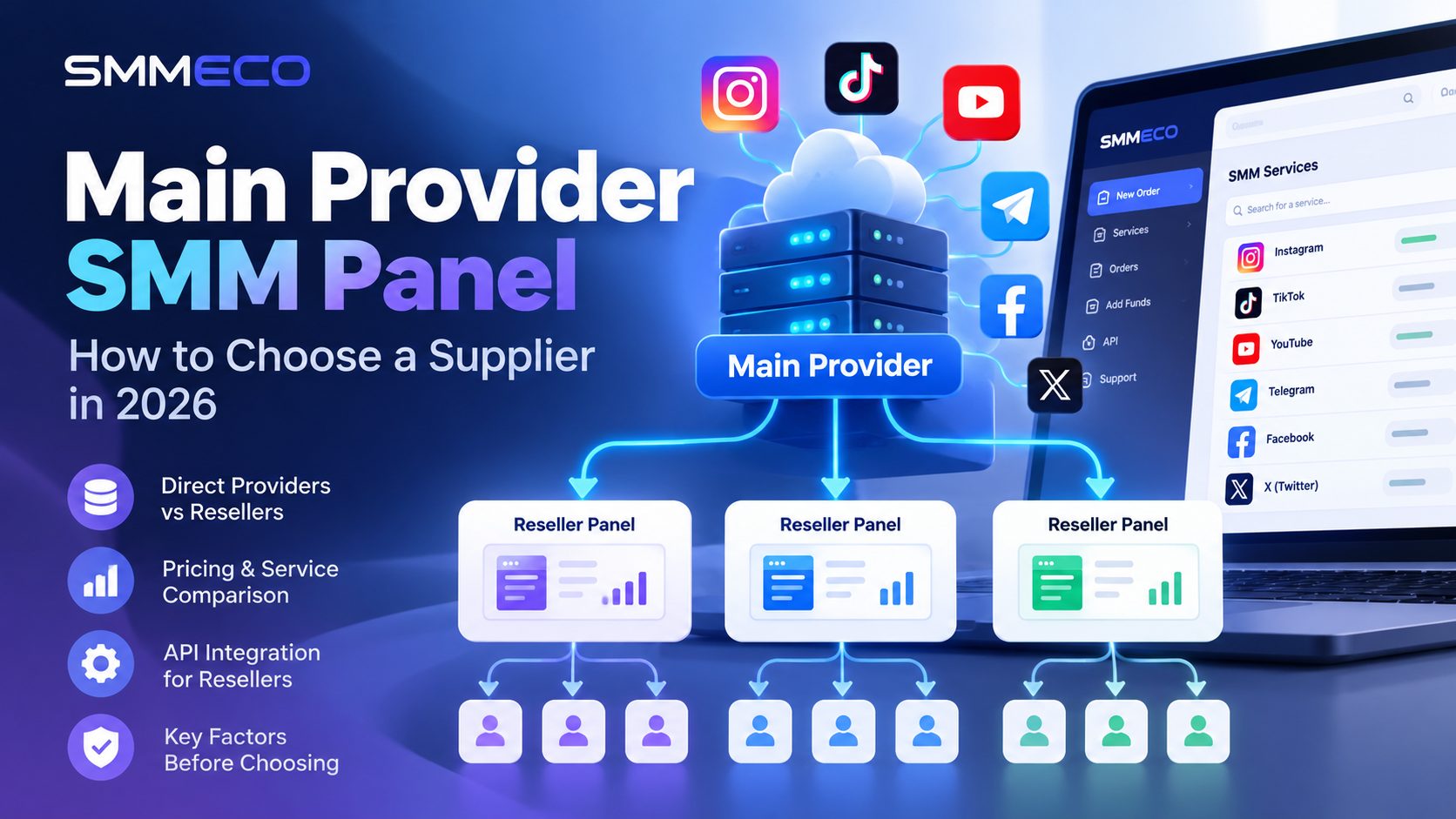
Main Provider SMM Panel in 2026: How to Choose a Supplier
Finding a main provider SMM panel is an important step for resellers, marketing agencies and businesses looking for affordable social media marketing services.
However, not every platform advertising itself as a direct SMM provider operates its own service infrastructure. Some panels supply services directly, while others rely on upstream suppliers or combine services from multiple sources.
Understanding these differences can help you compare provider pricing, evaluate API capabilities, review service conditions and make better purchasing decisions.
In this guide, we'll explain what a main SMM provider is, how the SMM supply chain works, and which factors matter when choosing an SMM panel provider in 2026.
What Is a Main Provider SMM Panel?
A main provider SMM panel generally refers to a platform that supplies social media marketing services to customers, agencies or other SMM panels.
In the SMM industry, the term "main provider" is often used to describe an upstream supplier that serves multiple reseller businesses.
These providers may offer services for platforms such as:
- TikTok
- YouTube
- Telegram
- X (formerly Twitter)
- Other social media platforms
A main provider may sell services through its own dashboard, an API connection or both.
Quick answer: A main provider SMM panel is commonly understood as an upstream supplier within the SMM service market. However, the term is not an official certification, and it does not automatically mean the company owns every service it sells.
This distinction matters when comparing direct suppliers with reseller platforms.
How Does the SMM Panel Provider System Work?
SMM panels can operate through different supply models.
A simplified service chain looks like this:
Service Source → SMM Provider → Reseller Panel → Customer
For example, an agency might place an order through a reseller panel. The reseller's system forwards the order to its connected provider, which handles the next stage of processing.
In other cases, a provider may also depend on additional upstream suppliers.
This means two panels can sell similar services while using completely different supply relationships.
Direct SMM Providers
A direct provider controls the underlying delivery process for the specific services it supplies.
This can provide more visibility into service conditions, but direct sourcing alone does not guarantee lower prices, better delivery or fewer problems.
SMM Aggregators
An aggregator combines services from multiple suppliers into one catalog.
For agencies and reseller businesses, this can simplify access to different service categories without managing a separate account with every supplier.
SMM Reseller Panels
A reseller panel usually obtains services from an upstream provider and offers them to customers through its own website.
Resellers may manage their own pricing, customer relationships, support systems and branding.
A business can operate as a direct supplier for some services and a reseller for others.
Main Provider vs Reseller SMM Panel: Key Differences
Although their websites may look similar, main providers and reseller panels can have different operational responsibilities.
Service Sourcing
A direct supplier controls the underlying service it provides. A reseller generally obtains that service from another business.
However, an API provider may itself be an aggregator rather than the original source.
Pricing Structure
Resellers commonly include a markup in their prices to cover business expenses and earn a profit.
This does not necessarily mean direct providers always offer lower rates.
Volume-based agreements, promotional prices, operating expenses and differences between services can all influence the final price.
Customer Support
A reseller typically handles communication with its own customers.
If an order encounters a problem, the reseller may need to contact its upstream provider before it can offer a resolution.
API Integration
Both providers and reseller panels may offer an API.
An API allows customers to access supported functions programmatically, but it does not prove that the platform operates its own service sources.
Service Catalog Management
Main providers and aggregators may manage extensive catalogs containing services from different categories.
Resellers often select, reorganize or rename services to create catalogs suited to their customers.
The important distinction is not simply whether a panel calls itself a provider or reseller. It is understanding which features, responsibilities and conditions apply to the services you intend to use.
How to Identify a Suitable Main SMM Provider
There is no universal test that proves whether a panel is a direct provider.
Instead, use a structured evaluation process.
1. Review the Service Catalog
A useful SMM panel catalog should make it easy to compare important service information.
Look for:
- Service ID and description
- Minimum order quantity
- Maximum order quantity
- Price per 1,000 units, where applicable
- Available refill conditions
- Cancellation availability
- Service-specific limitations
A large catalog can be useful, but the number of services alone does not prove direct sourcing.
2. Compare Equivalent Service Prices
When evaluating a cheap SMM provider, avoid comparing services based only on similar names.
Two services may differ in quantity limits, delivery conditions, refill guarantees or other important features.
A fair comparison should use the same order quantity and comparable service specifications.
3. Examine Service Policies
Before selecting a provider, understand what happens if an order is delayed, partially completed or loses previously delivered quantities.
Refill guarantees may only apply to certain services and may include conditions or exclusions.
Likewise, an order with a cancellation option may not remain eligible for cancellation after processing begins.
4. Evaluate Order Management
A practical provider dashboard should allow customers to review their orders and understand the available status information.
This becomes particularly important for agencies and businesses managing many orders.
5. Review Payment Conditions
Check the supported payment methods, minimum deposit requirements and account balance policies.
Some SMM panels operate primarily through cryptocurrency payment systems, while others may support additional methods.
Never assume that a payment method is available without checking the specific provider's current conditions.
6. Evaluate Customer Support
Before relying on a provider for business operations, review its support channels and communication procedures.
Clear support processes can make it easier to investigate pending orders, understand refund decisions and resolve service-related questions.
7. Check Platform Compliance and Account Risks
Third-party services that artificially inflate engagement metrics may violate social media platform rules.
For example, YouTube explicitly prohibits artificial increases in views, likes and other engagement metrics.
Review the relevant platform policies, avoid sharing unnecessary login credentials and do not assume that an SMM service is risk-free.
Is a Main Provider SMM Panel Always Cheaper?
No. Being described as a main provider does not guarantee the lowest prices.
Consider this hypothetical example:
A reseller purchases a service for $0.20 per 1,000 units and offers it to customers at $0.30.
The reseller's gross difference is $0.10 per 1,000 units before operating expenses.
However, another reseller might negotiate a better supplier rate or apply a lower markup.
A direct supplier might also price its retail catalog differently from its wholesale agreements.
Therefore, the best approach is to compare actual service rates and conditions.
Understanding Reseller Profit Margins
For reseller businesses, revenue and profit are not the same.
A simple gross profit calculation is:
Gross Profit = Selling Price − Supplier Cost
For example:
- Supplier cost: $0.40
- Customer selling price: $0.65
- Gross profit: $0.25
- Gross profit margin: approximately 38.46%
These figures are hypothetical and exclude payment fees, refunds, support expenses, taxes and other operating costs.
Even when a service has a relatively low purchase price, additional expenses can reduce the actual profit.
What Is an SMM Panel API Provider?
An SMM panel API provider offers programmatic access to supported services and order-management functions.
For reseller businesses, API integration can reduce manual order entry and help organize large numbers of orders.
Depending on the provider, supported API functions may include:
- Retrieving available services and prices
- Submitting new orders
- Checking individual order statuses
- Checking multiple order statuses
- Retrieving account balance
- Requesting refills for eligible orders
- Requesting cancellation when supported
Not every provider offers all these functions.
Why API Integration Matters for Resellers
Imagine a reseller platform receiving hundreds of customer orders.
Without an integration, staff may need to enter orders manually and update their status individually.
With an appropriate API integration, supported tasks can be processed automatically.
However, automation introduces its own operational requirements.
Resellers should evaluate how the provider handles connection errors, duplicate submissions, service ID changes and unexpected responses.
API credentials should also be protected and never exposed in public website code.
Does Having an API Make a Panel a Main Provider?
No.
A reseller can connect to an upstream API while offering its own API to other customers.
For example:
Customer → Reseller API → Upstream Provider API → Service Source
API availability demonstrates that a platform supports automation. It does not establish ownership of the underlying service.
How to Compare SMM Provider Costs
Choosing a provider based only on the lowest advertised price can lead to an incomplete comparison.
A useful assessment should include three different cost categories.
Service Cost
This is the amount charged for the original order.
The cost depends on the service rate, order quantity and pricing structure.
Operational Cost
Operational costs may include payment processing, support time, technical maintenance and managing unsuccessful orders.
For resellers, these expenses should be considered alongside supplier pricing.
Service Risk
Service performance may vary, and third-party engagement services may be affected by delivery limitations, changing platform rules or other external factors.
A lower-priced service is not necessarily the better choice if its conditions are unsuitable for your business.
Compare pricing and risk separately instead of assuming that one number represents overall value.
A Practical Checklist for Evaluating SMM Panel Providers
Before selecting a provider for recurring business use, follow a consistent review process.
Step 1 — Define your requirements.
Identify the platforms, service types, order quantities and management tools you actually need.
Step 2 — Compare service descriptions.
Review the service limits, refill conditions and cancellation policies.
Step 3 — Calculate expected costs.
Include supplier rates and any additional operational expenses.
Step 4 — Review API documentation.
If automation matters to your business, check the available endpoints, authentication requirements and supported order operations.
Step 5 — Evaluate support procedures.
Understand how the provider handles disputed, delayed, partially completed or unsuccessful orders.
Step 6 — Assess service and account risks.
Consider the platform policies and potential consequences associated with the service type.
Step 7 — Reassess periodically.
Provider catalogs, prices and service conditions may change. A provider that fits your needs today may not offer the same terms indefinitely.
This checklist provides a more practical basis for selecting an SMM panel provider than promotional claims alone.
Common Mistakes When Choosing a Main Provider SMM Panel
Choosing Based on Price Alone
A low price is attractive, but it does not explain service conditions or overall cost.
Assuming Every Provider Is a Direct Source
A provider may use several upstream companies. The term "main provider" does not establish service ownership.
Ignoring Refill Conditions
Not every service includes refill support. Guarantees may also depend on account changes, service conditions and specific eligibility rules.
Overlooking API Limitations
Before building an automated reseller workflow, verify that the API offers the functions your business actually requires.
Using One Provider for Every Requirement
A single provider may not offer suitable conditions across every platform and service category.
Some businesses evaluate multiple suppliers based on their individual needs.
Ignoring Social Media Platform Rules
Artificial engagement may violate platform policies and can create risks for accounts or channels. Provider marketing claims do not remove those risks.
Explore SMM Services with SMMECO
SMMECO is a global SMM panel platform designed for customers researching social media marketing services and managing orders.
The platform focuses on services for major social media networks, including Instagram, TikTok, YouTube and Telegram.
When comparing services, customers should review the current catalog, pricing and individual service conditions before placing an order.
Resellers and marketing agencies should also assess the ordering features and technical capabilities available to their accounts.
If you are researching an affordable SMM panel provider, you can explore SMMECO and its available services.
Frequently Asked Questions
What is a main provider SMM panel?
A main provider SMM panel generally refers to an upstream supplier offering social media marketing services to customers or reseller platforms. The term is informal and does not guarantee that a business operates every service directly.
What is the difference between a main SMM provider and a reseller?
A main provider commonly acts as an upstream supplier, while a reseller generally purchases services from another source and sells them through its own platform. Some companies perform both roles for different services.
Is a main provider SMM panel cheaper than a reseller?
Not always. Prices depend on supplier agreements, service specifications, markups, operating costs and other factors. Compare equivalent services instead of relying on the provider label.
How can I find an SMM panel provider for reselling?
Review service catalogs, pricing, API documentation, payment conditions, order-management features and support procedures. Evaluate platform-policy risks before selecting a service.
Can an SMM panel reseller offer an API?
Yes. A reseller may provide API access to its customers while forwarding supported orders to upstream providers through another API connection.
What is a wholesale SMM panel?
A wholesale SMM panel generally refers to a platform offering services to resellers or businesses, often using pricing structures or features suited to higher order volumes. Wholesale terminology does not guarantee that every listed price is the lowest available.
Are direct SMM providers always more reliable?
No. Reliability depends on multiple factors, including service conditions, operational systems, support procedures and the underlying service sources. Direct sourcing alone does not guarantee a particular outcome.
Final Thoughts
Choosing a main provider SMM panel requires more than finding a website that advertises itself as a direct supplier.
Provider relationships, pricing structures, API functionality, refill conditions and customer support all deserve attention.
For reseller businesses and agencies, understanding these factors can help reduce uncertainty when selecting services and designing order-management processes.
A useful provider comparison focuses on verifiable features and clearly documented policies rather than relying on labels such as "main provider" or "cheapest."
Before choosing an SMM panel provider, make sure you understand what the platform offers, how its services work and which risks or limitations apply.