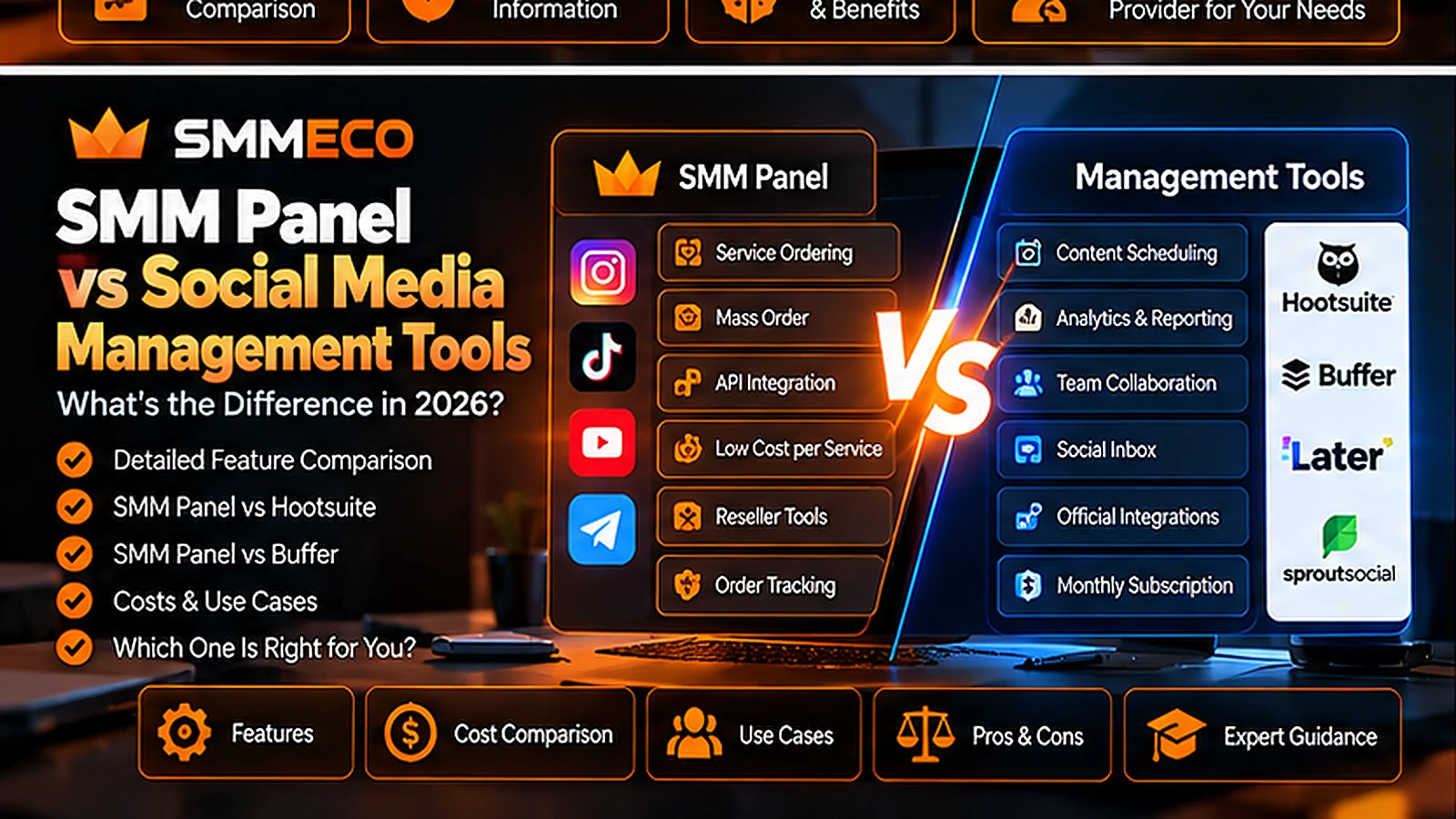
SMM Panel vs Social Media Management Tools: What's the Difference in 2026?
The terms SMM panel and social media management software are sometimes used as though they mean the same thing.
They don't.
Although both are associated with social media marketing, their purposes, features, pricing models, and typical users can be very different.
An SMM panel usually focuses on ordering and managing third-party social media services.
A social media management tool generally focuses on planning, publishing, analyzing, and managing a brand's own social media activity.
For example, platforms such as Buffer and Hootsuite provide tools for content scheduling and social media management.
An SMM panel such as SMMECO instead provides an account-based interface for selecting available social media service listings and managing related orders.
Understanding these differences helps businesses avoid buying the wrong kind of software.
In this guide, we'll compare both categories, examine their core features, and explain when each type of platform is relevant.
What Is the Difference Between an SMM Panel and a Social Media Management Tool?
An SMM panel is generally a service-ordering platform, while a social media management tool is software for organizing and operating social media marketing activities.
An SMM panel can include service catalogs, order submissions, account balances, API access, and order-status tracking.
A social media management tool may include content calendars, publishing schedules, analytics, collaboration features, and audience engagement workflows.
The main difference is their primary function.
Quick Answer: Use social media management software to plan, publish, monitor, and analyze marketing activity. An SMM panel is primarily designed to manage orders for listed third-party social media services. The two systems are not interchangeable.
SMM Panel vs Social Media Management: Feature Comparison
What Does an SMM Panel Do?
An SMM panel provides an interface for exploring and submitting available third-party service requests.
Common features include:
- Service categories and descriptions.
- Service IDs and quantity limits.
- Account funding and balances.
- Order submission interfaces.
- Order history and tracking.
- Support for eligible refill or cancellation requests.
- API integration for compatible reseller systems.
An individual customer may use an SMM panel to examine a particular service category.
A reseller may use the platform to manage orders associated with its own business.
An agency may maintain separate internal records for several approved projects.
However, an SMM panel should not automatically be treated as an all-in-one marketing platform.
A service-ordering dashboard does not necessarily provide campaign analytics, content planning, audience research, or an editorial calendar.
What Do Social Media Management Tools Do?
Social media management tools are designed to help businesses operate their own social accounts.
Their features often cover the full content lifecycle.
Content Planning
Teams can organize ideas, campaign themes, publishing dates, and editorial responsibilities.
Scheduling and Publishing
Users can prepare posts and schedule supported content for future publication.
Analytics and Reporting
Management software may provide metrics related to published content, audience engagement, reach, clicks, and campaign performance.
Community Management
Some platforms consolidate incoming messages, comments, and other interactions.
Team Collaboration
Businesses may assign permissions, review content, and coordinate work among several staff members.
These features are particularly relevant to brands publishing original content and managing ongoing customer relationships.
Buffer vs SMM Panel: Different Types of Automation
Buffer is an example of social media management software.
According to its official documentation, Buffer allows users to connect supported social channels, prepare content, and schedule posts.
Its publishing workflow includes selecting channels, composing content, and choosing a publishing time.
That is a different kind of automation from an SMM panel API.
For example:
Buffer-style workflow: Prepare a social media post and schedule publication.
SMM panel workflow: Select a service listing, submit an eligible order, and track its reported status.
Both may involve automated systems, but they automate different activities.
Does Buffer Sell SMM Panel Services?
Buffer is positioned as social media publishing, analytics, and engagement software.
It should not be described as an SMM panel or assumed to offer the same third-party service catalog.
Hootsuite vs SMM Panel: What Changes for an Agency?
Hootsuite is another example of social media management software.
Its official platform information describes publishing, analytics, social listening, reporting, and inbox functionality.
These capabilities help teams manage social media activity and customer communication.
An SMM panel generally focuses on service orders rather than ongoing social media operations.
For example, an agency using Hootsuite may plan posts, review analytics, and respond to messages.
An agency using an SMM panel may separately investigate eligible supplier services and maintain the corresponding order records.
These tasks have different purposes.
Is Hootsuite a Replacement for an SMM Panel?
Not directly, because the two product categories do different things.
However, an agency focused on legitimate content marketing, audience analytics, and community management may find that a management tool better addresses its actual needs.
The correct choice depends on the work the agency intends to perform.
SMM Panel API vs Social Media Management API
The term API appears in both categories, but the underlying operations can differ.
SMM Panel API
An SMM panel API may support:
- Retrieving listed supplier services.
- Submitting orders.
- Checking order statuses.
- Reading available account balances.
- Requesting supported refills or cancellations.
For example, the SMMECO API documents service-list, order, status, and balance operations.
Social Media Management API
A management platform API may support functions related to content, channel administration, publishing, or reporting, depending on the provider and supported social network permissions.
For example, Buffer publishes developer documentation describing its API resources.
Why Does This Difference Matter?
A developer integrating one category should not assume the other uses equivalent request structures or permissions.
A service-order API does not automatically provide official social network publishing access.
Likewise, a social media publishing API does not imply access to third-party engagement service catalogs.
How Do Pricing Models Differ?
Many SMM panels use a prepaid balance or per-service pricing structure.
For example, a service with a rate per 1,000 units may calculate its estimated charge as:
Quantity ÷ 1,000 × Published Rate
However, payment requirements and pricing structures vary by provider.
Social media management software often uses subscriptions based on features, accounts, users, or usage limits.
The total price may depend on the number of connected channels and required capabilities.
Example: Comparing Business Expenses
Consider a hypothetical small agency with a monthly marketing operations budget.
It may allocate:
- $80 to a social media management software subscription.
- $150 to legitimate advertising campaigns.
- $60 to design and content production tools.
These values are illustrative budget assumptions, not current prices for Buffer, Hootsuite, or SMMECO.
The agency should judge each expense by the business problem it solves.
A low-cost service-ordering tool does not replace analytics software simply because it costs less.
Which Is Better for Small Businesses?
For most businesses focused on sustainable content marketing, a social media management tool can help with recurring tasks such as scheduling, reporting, and audience communication.
An SMM panel is a different type of service platform and should be evaluated independently.
Businesses should consider whether the specific third-party services are legitimate, permitted, and useful before paying for them.
The decision should begin with a marketing objective rather than the category name.
If Your Goal Is Content Publishing
Look for publishing and scheduling tools.
If Your Goal Is Audience Analytics
Look for reporting and measurement capabilities.
If Your Goal Is Customer Communication
Consider social inbox and community management features.
If Your Goal Is Supplier Order Administration
An SMM panel may provide relevant service-ordering and status-management capabilities, subject to the selected services and platform rules.
Can Marketing Agencies Use Both Types of Software?
Yes, an agency may operate several software systems for different administrative purposes.
For example, an agency might use management software for content planning and reporting, while maintaining a separate supplier-order system for authorized and compliant activities.
However, these systems should not be confused when reporting results.
A supplier's Completed status does not independently establish authentic audience growth or marketing effectiveness.
Agency reports should distinguish operational records from verified marketing outcomes.
Are SMM Panel Services the Same as Official Social Media Advertising?
No.
Advertising platforms such as Meta Ads or Google Ads provide advertising products under their respective platform rules and account requirements.
Third-party SMM engagement services are separate.
They should not be represented as equivalent to official advertising products.
Artificial engagement, deceptive metrics, and prohibited automation can create policy and legal risks.
An SMM panel's scheduling or drip-feed features do not remove those risks.
How SMMECO Fits Into the Comparison
SMMECO provides a global SMM panel interface focused on social media service categories and order management.
Its publicly described features include Mass Order, supported drip-feed functionality, account funding, and API access.
These features are associated with supplier service ordering rather than general-purpose content calendar management.
SMMECO should therefore be evaluated as an SMM panel, not as a substitute for dedicated social media management software.
For a broader explanation of SMM provider selection, read our SMM Panel Provider Comparison Guide.
Frequently Asked Questions
Is an SMM panel the same as social media management software?
No. An SMM panel primarily manages service orders, while social media management software helps businesses publish, monitor, and analyze their social channels.
Is Hootsuite an SMM panel?
No. Hootsuite is a social media management platform with tools for publishing, analytics, listening, and communication.
Is Buffer an SMM panel?
No. Buffer focuses on social media publishing, scheduling, analytics, and engagement workflows.
Do SMM panels schedule posts?
Post scheduling is not necessarily a standard SMM panel feature. Some panels offer drip-feed scheduling for eligible service orders, which is different from scheduling original social posts.
Is an SMM panel cheaper than social media management software?
The pricing models differ. A per-service rate and a monthly software subscription are not directly equivalent.
Which tool should an agency use?
Choose software according to the intended tasks, required permissions, budget, and relevant platform policies. Agencies may need multiple specialized tools.
Does SMMECO provide content scheduling software?
SMMECO's public features focus on service ordering, account management, Mass Order, drip feed, and API tools. Dedicated social post scheduling should not be assumed.
Final Thoughts
SMM panels and social media management tools serve different functions.
A management platform helps businesses plan and operate their social media activity.
An SMM panel is typically used to explore and manage listed third-party service orders.
Understanding this distinction helps businesses choose software based on actual operational needs.
For legitimate growth, publishing useful content, understanding the audience, and measuring meaningful performance remain essential.
To explore the capabilities of an SMM service-ordering platform, visit SMMECO.
Key takeaway: Choose the right software for the task. An SMM panel and a social media management platform are different products, not interchangeable solutions.