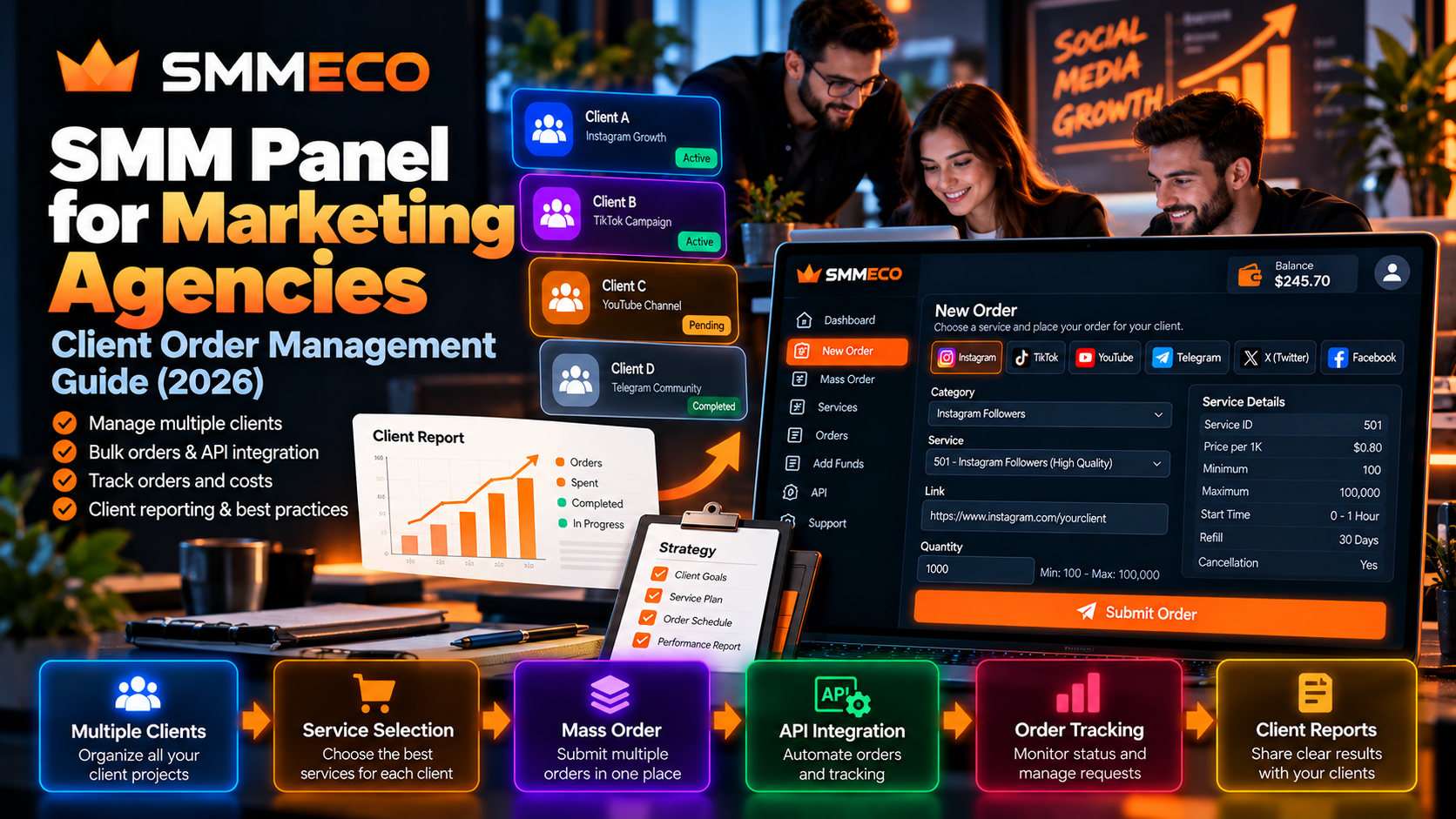
SMM Panel for Marketing Agencies: Complete Client Order Management Guide (2026)
Managing social media services for one client is relatively straightforward. Managing requests from 10 or 20 different clients is another story.
Different projects have different budgets, deadlines, target links, approval requirements, and reporting expectations. When several clients submit requests around the same time, even a small administrative mistake can become expensive.
An incorrect Service ID could result in the wrong service being selected. A duplicated request could create an unnecessary charge. And a supplier order that hasn't started may leave an agency struggling to explain the situation to its customer.
This is why SMM panel order management for marketing agencies requires more than simply finding a low-priced provider.
Agencies need an organized system for reviewing requests, managing approved services, monitoring supplier activity, tracking costs, and communicating accurate information to clients.
An SMM panel for marketing agencies can provide access to centralized ordering tools, bulk submission features, and API-based operations where supported.
For example, SMMECO offers a global SMM panel with multiple social media service categories, order management, Mass Order functionality, and documented API operations.
In this guide, we'll explore how agencies can organize their SMM panel workflows, avoid common operational mistakes, monitor multiple orders, and evaluate supplier costs without relying on unrealistic service guarantees.
What Is an SMM Panel for Marketing Agencies?
An SMM panel for marketing agencies is an online platform that agencies can use to access, submit, and monitor available social media service orders from a centralized account.
Depending on the provider, the platform may offer services associated with Instagram, TikTok, YouTube, Telegram, and other social networks.
An agency may use the platform to research available service categories, review pricing, prepare authorized requests, and maintain order records.
Some SMM panels also offer additional tools such as Mass Order and API access.
These features can reduce repetitive administrative tasks, particularly when an agency handles requests for several clients.
However, an SMM panel is not automatically a complete agency management platform.
A marketing agency may still require separate tools for client communication, project approvals, billing, access control, and reporting.
Quick Answer: An SMM panel helps marketing agencies organize social media service ordering and tracking. Effective agency management also requires client authorization, accurate records, appropriate service selection, budget controls, and reliable communication.
Why Marketing Agencies Need Organized SMM Order Management
The operational needs of an agency are different from those of an individual customer.
A single customer may only need to track one order.
An agency might have multiple requests for several clients, with different staff members responsible for approving, submitting, and monitoring them.
Without a clear process, these requests can become difficult to manage.
Multiple Client Projects
Different clients may use different platforms and have different requirements.
One client may operate Instagram and TikTok accounts.
Another may manage a YouTube channel.
A third may operate a Telegram community.
Each project requires its own records and authorization.
Different Service Requirements
Even services with similar names may have different minimum quantities, supported links, delivery conditions, and cancellation rules.
Selecting the wrong listing can cause avoidable complications.
Budget Tracking
An agency needs to distinguish the cost of an upstream service from the amount charged to its client.
Payment fees, staff time, service adjustments, and support overhead can affect the final project cost.
Order Status Monitoring
Customers may ask whether a service has started, completed, or encountered a problem.
The agency should be able to identify the correct order and communicate its verified status.
Client Reporting
A supplier's Completed status is an operational record.
It does not automatically prove audience growth, higher engagement quality, or better business results.
Agencies need to distinguish supplier delivery information from real marketing performance.
How Does an Agency SMM Panel Workflow Work?
An organized workflow usually begins before an order is submitted.
Consider the following process:
Client Request → Internal Review → Client Approval → Service Selection → Order Submission → Status Monitoring → Reconciliation → Client Report
Each stage has a specific purpose.
1. Client Request
The agency receives a request or identifies a legitimate marketing requirement within an agreed project scope.
2. Internal Review
The team checks the target, service requirements, expected cost, and applicable social media platform policies.
3. Client Approval
The client authorizes the activity, budget, and relevant service conditions.
4. Service Selection
The agency identifies a suitable available service and verifies its current specifications.
5. Order Submission
An authorized team member submits the request through the supported ordering interface.
6. Status Monitoring
The agency tracks the accepted order using its Order ID.
7. Reconciliation
The team checks whether the final status, recorded charges, and any adjustments are consistent.
8. Client Reporting
The client receives an accurate account of what was requested, what the supplier reported, and what outcomes were independently measured.
This structure reduces the risk of confusing internal agency records with upstream supplier information.
How to Manage Multiple Clients With One SMM Panel
One common question is whether an agency can manage multiple client projects through a single supplier account.
Operationally, an agency can maintain separate client records while submitting eligible requests through its authorized supplier account, subject to the provider's terms.
However, this does not mean the supplier necessarily offers dedicated client subaccounts, shared team dashboards, or built-in agency workspaces.
Those capabilities must be verified individually.
Create a Unique Internal Client Reference
Every client should have a consistent internal identifier.
For example:
- Client A:
AG-001 - Client B:
AG-002 - Client C:
AG-003
These are illustrative agency references, not SMMECO account or order IDs.
The purpose is to connect requests, approvals, invoices, and reports to the correct client.
Separate Client Requests From Supplier Orders
An internal project request and an upstream supplier order are different records.
Suppose your agency receives a request from Client A and assigns it internal reference AG-001-REQ-12.
After an authorized service request is submitted, the supplier may return an Order ID such as 85021.
Your records should preserve both references.
Internal Reference: AG-001-REQ-12
Supplier Order ID: 85021
Supplier: Example Provider
Service ID: 205
Current Status: Pending
All identifiers in this example are hypothetical.
Maintaining both references makes it easier to identify the correct transaction if the client contacts support later.
Record Client Authorization
Agencies should retain evidence of approval for relevant service requests.
A client approving a marketing budget is not necessarily the same as approving every possible third-party service.
The agreed scope should identify the permitted activities and relevant risks.
Never use a client's credentials, confidential information, or social media account access without appropriate authorization.
Build a Client Order Management Worksheet
A simple order worksheet can prevent many of the mistakes that occur when agencies manage multiple projects.
You do not need a sophisticated system to begin.
A spreadsheet or properly configured project management tool can be sufficient for a small team.
Essential Fields to Record
Client Reference
Identifies the client or project.
Internal Request ID
Identifies the agency's own request.
Supplier Name
Identifies the upstream provider.
Service ID
Identifies the supplier's selected service.
Target Link
Records the approved target associated with the request.
Quantity
Shows the approved requested amount, where applicable.
Supplier Order ID
Identifies the accepted order.
Supplier Cost
Records the charge associated with the order.
Submission Date
Shows when the order was submitted.
Current Status
Records the latest confirmed supplier status.
Assigned Team Member
Identifies who is responsible for monitoring the request.
Client Approval Reference
Links to the relevant authorization.
Last Checked
Records when the order information was most recently verified.
Why Is This Worksheet Useful?
Imagine an agency handling 35 requests across eight clients.
Without consistent references, it can become difficult to determine which pending order belongs to which customer.
An organized worksheet allows the team to identify the responsible staff member, supplier order record, and outstanding issue without searching through unrelated messages.
For larger operations, the same structure can be implemented in an internal database or agency management system.
Mass Order for Marketing Agencies: When Is It Useful?
Marketing agencies may need to prepare multiple approved service requests during one administrative session.
In this situation, a Mass Order feature can be useful.
Mass Order allows multiple individual requests to be submitted through a single supported workflow.
For example, an agency might have several eligible requests associated with different approved targets.
Instead of opening a separate order form for every request, it may be possible to prepare a bulk submission.
Does SMMECO Offer Mass Order?
Yes.
SMMECO's public homepage describes a Mass Order feature that allows users to submit multiple orders with different links and quantities in one place.
This is relevant to agencies looking for convenient ways to manage multiple service requests.
However, users should confirm the accepted format and supported service categories inside their accounts.
Mass Order Does Not Mean One Combined Order
Several requests submitted together may still receive different Order IDs.
Each accepted request can also have different processing conditions and final outcomes.
A bulk submission does not automatically guarantee:
- Faster fulfillment.
- Wholesale discounts.
- Identical delivery conditions.
- Automatic approval of every submitted line.
- Combined billing for all requests.
An agency should verify which requests were actually accepted before updating client records.
For a dedicated explanation, read our SMM Panel Mass Order Guide.
SMM Panel API for Agencies: Automating Administrative Work
As the number of clients and requests increases, manual tracking can become time-consuming.
An API may allow an agency's internal software to communicate with an SMM panel.
A compatible integration can retrieve available service information, submit supported requests, check order records, and retrieve account information.
The exact available functions depend on the provider.
What Does the SMMECO API Support?
According to the official SMMECO API documentation, the platform uses:
API Endpoint: https://smmeco.com/api/v2
Method: HTTP POST
Response Format: JSON
Documented operations include:
services— Retrieve the available service catalog.add— Submit a supported service order.status— Retrieve order-status information.balance— Retrieve the account balance.refill— Request a supported refill.refill_status— Check refill request information.cancel— Submit a supported cancellation request.
SMMECO also documents checking up to 100 comma-separated Order IDs through a multiple-order status request.
How Can Agencies Use Status Retrieval?
Suppose an agency stores its client orders in an internal system.
The agency can develop an integration that retrieves the status of its accepted supplier orders through documented API operations.
The system can then associate those responses with the correct internal client references.
This may reduce the amount of manual checking required.
However, developers must distinguish between a successful API connection and a successful order operation.
Avoid Duplicate Paid Requests
A particularly important problem occurs when an API request times out.
Imagine an order is accepted by the supplier but the network connection fails before the agency receives the confirmation.
If the application immediately submits the same request again, a duplicate order could be created.
A safer workflow records the original submission and investigates uncertain results before retrying.
Protect Client and API Information
Private API credentials should remain on a secure server.
Do not expose them in public JavaScript, client-facing website code, or unsecured repositories.
Limit access to authorized staff members and store only information necessary for the relevant operation.
For a more detailed technical explanation, read our SMM Panel API Integration Guide for Resellers.
How to Track SMM Orders Across Multiple Client Projects
Order tracking becomes more useful when agencies separate the supplier's status from the internal project status.
For example, a supplier might report an order as Completed while the agency still needs to perform accounting checks and prepare the client report.
These are different tasks.
Supplier Order Status
Common states include:
Pending: The request has been recorded and is awaiting processing.
Processing / In Progress: The supplier reports that the order is being handled.
Completed: The system reports that fulfillment has finished.
Partial: The full requested quantity was not fulfilled.
Canceled: The order has been stopped under the applicable conditions.
These are operational labels, not guarantees of authentic engagement.
Internal Agency Status
An agency may use additional internal project states, such as:
Awaiting Approval: Client authorization is required.
Approved: The request has passed the agency's checks.
Submitted: The request has been sent to the supplier.
Needs Review: A discrepancy or uncertain submission requires investigation.
Reconciled: The final recorded charges and status have been checked.
Reported: The verified outcome has been communicated to the client.
These are suggested internal workflow labels, not official SMMECO status options.
Why Separate the Two?
Because a supplier transaction and a client project can progress independently.
An order may be marked Completed while the agency still needs to verify the charge or provide a client update.
Separating the records makes the workflow easier to manage and reduces misleading reporting.
For a complete explanation of supplier statuses, see our SMM Panel Order Status Guide.
SMM Panel Agency Pricing: How to Calculate Project Costs
A marketing agency needs to understand the difference between supplier costs and client revenue.
The lowest advertised SMM service rate does not necessarily produce the best financial outcome.
Example: Calculating an Agency's Gross Margin
Imagine an agency completes a hypothetical permitted client project with the following finances:
Client project revenue: $150
Direct supplier service costs: $45
Payment and transaction fees: $5
The direct project costs are:
$45 + $5 = $50
The gross contribution before agency labor and overhead is:
$150 − $50 = $100
The corresponding percentage of client revenue is:
($100 ÷ $150) × 100 = 66.67%
This example is hypothetical and does not represent actual SMMECO pricing, agency revenue, or guaranteed profitability.
Why This Is Not Final Profit
The agency may also have expenses such as:
- Staff time.
- Customer support.
- Software subscriptions.
- Taxes.
- Refunds and payment disputes.
- Project revisions.
- Client acquisition expenses.
- General business overhead.
These additional costs can reduce profitability.
What Should Agencies Monitor?
Track the direct cost of each approved request, the actual charge after any adjustment, and the revenue associated with the project.
Avoid calculating final profit solely from advertised service prices.
For a more detailed explanation of supplier economics, read our Wholesale SMM Panel Pricing and Reseller Margins Guide.
How to Handle Delayed or Partial Orders for Agency Clients
One difficult situation for an agency is explaining why a supplier request has not progressed as expected.
A client may expect immediate delivery while the service still reports Pending.
The agency should not invent a completion time or claim that the provider has resolved an issue without confirmation.
When an Order Is Delayed
First, verify the Order ID.
Then check the original submission time, current status, target link, and published service conditions.
If the estimated start period has passed, contact the supplier using its official support channel.
Record the investigation in the internal project history.
When an Order Is Partial
A Partial status generally means the provider reports that the full requested quantity was not fulfilled.
The agency should review:
- Original requested quantity.
- Recorded remaining quantity.
- Final supplier charge.
- Any confirmed balance adjustment.
- Applicable service conditions.
Do not automatically promise a full cash refund based only on the status label.
When a Cancellation Is Requested
A cancellation request does not always mean the order has been successfully canceled.
Eligibility depends on the service and processing stage.
The agency should verify the final outcome before making financial adjustments or submitting a replacement request.
For related conditions, see the SMM Panel Refill, Cancel & Drop Policies Guide.
Agency Team Roles: Who Should Handle Each Stage?
A clear division of responsibilities can improve accuracy.
This is particularly useful when several employees work with the same supplier account or client projects.
Account Manager
The account manager communicates with the client and confirms project requirements.
They also maintain the approval record and explain verified outcomes.
Operations Specialist
The operations specialist reviews the selected service, checks request details, and handles authorized submissions.
Technical Administrator
For agencies using API integrations, the technical administrator maintains supplier connections, monitors errors, and protects credentials.
Finance or Billing Team
The finance function reconciles supplier charges, account deposits, adjustments, and client invoices.
Quality Reviewer
A reviewer can check important requests before submission and investigate discrepancies after processing.
These roles do not necessarily require five separate employees.
A small agency may assign several responsibilities to one person.
The important point is that each stage has a clear owner.
Practical Example: Managing Three Clients With One Agency Workflow
Consider a hypothetical agency with three clients.
Client A: An educational content publisher.
Client B: A software company.
Client C: A community-based organization.
Each client has different marketing goals and approved activities.
Phase 1: Record Requirements
The account manager records the platform, objective, approved budget, and relevant permissions for each client.
Phase 2: Check Service Suitability
The operations specialist reviews whether any proposed third-party service is suitable, correctly described, and compatible with relevant platform policies.
Activities that are prohibited, misleading, or unauthorized are rejected.
Phase 3: Assign Internal References
The agency creates:
AG-001for Client A.AG-002for Client B.AG-003for Client C.
Each individual request receives another unique internal reference.
Phase 4: Submit Eligible Requests
Only approved and permitted requests proceed to the ordering stage.
Where supported, the agency may use Mass Order or an authorized API integration.
Phase 5: Record Results
After submission, the agency records each accepted supplier Order ID and the corresponding cost.
Uncertain submissions are flagged for review instead of being automatically repeated.
Phase 6: Monitor Progress
The team checks recorded supplier statuses and investigates exceptions.
Phase 7: Prepare Client Reports
Each client receives information about its own approved activities and costs.
The report separates operational delivery from meaningful campaign performance, such as qualified inquiries, relevant audience engagement, or website conversions.
This process is more useful than relying on a single spreadsheet column labeled Completed.
What Should an Agency Include in Its SMM Client Reports?
A client report should distinguish administrative activity from measurable marketing outcomes.
Operational Reporting
Operational reports can contain:
- Approved service requests.
- Submission dates.
- Supplier Order IDs.
- Current or final statuses.
- Recorded charges.
- Confirmed adjustments.
- Outstanding support issues.
Marketing Performance Reporting
Where relevant and reliably measured, campaign reporting may include:
- Website visits from social platforms.
- Qualified leads.
- Conversion rates.
- Genuine audience engagement.
- Click-through rates.
- Community participation.
- Campaign spending.
- Return on advertising investment.
These metrics should be derived from suitable analytics tools and legitimate campaign activity.
Why the Difference Matters
An SMM panel can report that a service order is Completed.
That does not prove the campaign generated real customers, increased organic reach, or created genuine engagement.
Agencies should avoid presenting third-party purchased metrics as organic audience growth.
Accurate reporting supports better decisions and more transparent client relationships.
How to Evaluate an SMM Panel for Agency Use
When selecting a supplier, agencies should evaluate features against their actual operating requirements.
Service Catalog
Does the platform provide clearly described categories relevant to the agency's permitted activities?
Order Tracking
Can accepted orders be identified and monitored reliably?
Mass Order Functionality
Does the platform support an appropriate bulk submission workflow?
API Documentation
Are the supported operations, authentication requirements, and parameters documented?
Pricing Transparency
Are rates, quantity limits, and relevant service restrictions visible before purchase?
Account Funding
Are payment methods and account-balance conditions understandable?
Support
Is there a clear method for requesting assistance with an existing Order ID?
Security
Can the agency protect its account credentials and use the available tools without exposing client information?
Platform Compliance
Are service risks understandable, and can the agency avoid activities prohibited by social media platforms?
No provider should be selected solely because its homepage claims to be the cheapest or best.
SMMECO for Marketing Agencies: Available Features
SMMECO positions itself as an affordable global SMM panel for resellers and marketing agencies.
Its public website advertises several features relevant to agency operations.
Multi-Platform Service Categories
SMMECO identifies Instagram, TikTok, YouTube, and Telegram among the platforms covered by its service catalog.
Actual service availability depends on the current listings.
Centralized Order Management
The platform describes the ability to place and track service orders through one account-based system.
Mass Order
SMMECO publicly advertises a Mass Order function for submitting multiple requests with different links and quantities.
API Functionality
Its public API reference documents service retrieval, order creation, status checks, account balance retrieval, and certain refill and cancellation operations.
Cryptocurrency Account Funding
SMMECO describes cryptocurrency-based account funding through its available payment methods.
Customers should confirm the current supported currencies, networks, and deposit conditions before transferring funds.
Important Feature Limitations
These publicly documented features do not establish that SMMECO offers every capability found in dedicated agency management software.
For example, agencies should independently verify whether they need and can obtain:
- Multiple staff logins.
- Client-specific subaccounts.
- Built-in project approval workflows.
- White-label reporting.
- Direct CRM integrations.
- Role-based permissions.
- Dedicated account management.
Those capabilities should not be assumed unless the provider explicitly confirms them.
Security and Compliance for Agencies Using SMM Panels
Agency responsibilities extend beyond placing orders.
Working on behalf of clients creates additional obligations involving authorization, accurate representations, and information protection.
Obtain Proper Client Authorization
Do not submit requests for client accounts or content without appropriate permission.
Document what the client has approved.
Respect Social Media Platform Policies
Certain paid engagement practices can violate the rules of Instagram, TikTok, YouTube, Telegram, and other platforms.
Gradual delivery or an API-based workflow does not make prohibited artificial engagement acceptable.
Avoid Misleading Client Reports
Never present artificial engagement as independently verified organic audience growth.
Protect API Credentials
Keep supplier API keys in secure server-side systems.
Avoid exposing credentials in publicly accessible source code or documents.
Minimize Sensitive Data
Only collect and share information necessary for the approved service and related administration.
Understand Refund and Cancellation Rules
Review the supplier's service conditions before making commitments to customers.
SMMECO's Terms of Service describe relevant account security, payment, order-processing, and reseller responsibilities.
Frequently Asked Questions About SMM Panels for Marketing Agencies
What is an SMM panel for marketing agencies?
An SMM panel for marketing agencies is a platform that agencies can use to access available social media service categories and manage eligible orders. Depending on the provider, it may include centralized order tracking, bulk submission, and API tools.
Can marketing agencies manage multiple clients through an SMM panel?
Agencies can organize requests for different clients using internal project references and supplier order records, subject to authorization and platform terms. Dedicated client subaccounts and team management features depend on the provider.
What is the difference between an agency SMM panel and a reseller SMM panel?
The core ordering tools may be similar. Agencies typically focus on managing marketing projects for clients, while reseller businesses primarily focus on selling services through their own storefronts. One business can operate in both roles.
Does an SMM panel replace agency project management software?
Not necessarily. SMM panels generally focus on service ordering and related account functions. Agencies may still need CRM, approval, reporting, billing, and collaboration tools.
What is Mass Order in an agency SMM panel?
Mass Order allows several individual requests to be submitted through one supported ordering workflow. It can reduce repetitive manual entry but does not automatically provide discounts or guarantee faster fulfillment.
Can agencies automate SMM panel orders with an API?
Some SMM panels provide APIs for compatible software integrations. Available operations may include service retrieval, order submission, status checks, and balance information. Agencies should follow the specific provider's documentation and access restrictions.
How should agencies track supplier orders?
A useful approach is to retain the client reference, internal request ID, supplier, Service ID, external Order ID, submission timestamp, charge, and current status. This makes support and accounting easier.
Does SMMECO provide an API for agency use?
SMMECO publishes API documentation covering supported service and order operations. Agencies should verify current access and integration requirements through the platform.
Can SMMECO submit multiple orders at once?
Yes. SMMECO's public website describes Mass Order functionality for submitting multiple requests with different links and quantities.
How can agencies avoid duplicate SMM orders?
Maintain unique internal request references, verify whether an order was accepted, check existing orders for the same target, and investigate uncertain API submissions before retrying.
Is the cheapest SMM panel always best for agencies?
No. Service suitability, accurate documentation, account security, payment conditions, order tracking, and support can be as important as the advertised price.
Can SMM panels guarantee organic growth for agency clients?
No. An SMM panel order status does not prove genuine audience participation, improved search visibility, increased sales, or long-term organic growth.
Final Thoughts: Building a Better SMM Panel Workflow for Agencies
Managing an SMM panel for an agency involves more than processing individual requests.
As the number of clients grows, accurate records, clearly assigned responsibilities, client approvals, and reliable order tracking become increasingly important.
Mass Order functionality can make multiple submissions more convenient.
API integration can help connect supported supplier operations with an agency's internal software.
However, neither feature replaces good operational controls.
Agencies should maintain a clear connection between client requests, supplier records, actual costs, and final reporting.
They should also distinguish supplier order completion from legitimate marketing results.
SMMECO offers centralized ordering, Mass Order functionality, documented API operations, and service categories covering several major social platforms.
Agencies interested in these features can explore SMMECO — Global SMM Panel and review the current service conditions.
Key takeaway: The best SMM panel workflow for a marketing agency is one that keeps client requests organized, protects account information, prevents duplicate orders, and communicates verified outcomes accurately