Wholesale SMM Panel Pricing: Reseller Costs & Profit Margins in 2026
Understanding wholesale SMM panel pricing is essential for anyone planning to start or expand an SMM reseller business.
When comparing SMM panel providers, reseller businesses often focus on finding the cheapest supplier rates. However, a low wholesale price does not automatically mean a higher profit margin.
Payment fees, service-related adjustments, customer support costs and supplier price changes can all affect how much money a reseller actually keeps.
For businesses managing multiple customer orders, having a clear pricing strategy is just as important as choosing a suitable SMM panel provider.
In this guide, we'll explain how wholesale SMM pricing works, how resellers calculate profit margins, which expenses to consider and how to build a sustainable service pricing strategy in 2026.
What Is a Wholesale SMM Panel?
A wholesale SMM panel is an online platform offering social media marketing services to businesses, agencies or resellers.
These platforms commonly provide services associated with social networks such as:
- TikTok
- YouTube
- Telegram
- X (formerly Twitter)
Depending on the supplier, services may be offered through a website dashboard, an API or both.
A reseller typically obtains services from a provider and makes them available through its own customer-facing platform.
Quick Answer: Wholesale SMM panel pricing refers to the rates offered to reseller businesses for social media marketing services. To calculate reseller profitability, businesses must consider the supplier rate, selling price, payment fees, support expenses, expected adjustments and other operating costs.
The term "wholesale" does not guarantee the lowest available market price or prove that a supplier operates every listed service directly.
How Does Wholesale SMM Panel Pricing Work?
Many SMM panels display service prices using a rate per 1,000 units.
For example, a supplier might advertise a hypothetical service at $0.30 per 1,000 units.
If a reseller orders 5,000 units, the calculated supplier cost would be:
5,000 ÷ 1,000 × $0.30 = $1.50
This basic pricing model makes it easier to compare services offered at different quantities.
However, not every SMM service uses the same pricing structure.
Some services are sold as fixed packages, subscriptions or other billing units.
Before importing a service into a reseller catalog, confirm how the supplier calculates the price.
Understanding the Price per 1,000 Units
For quantity-based services, the general formula is:
Supplier Order Cost = (Order Quantity ÷ 1,000) × Supplier Rate
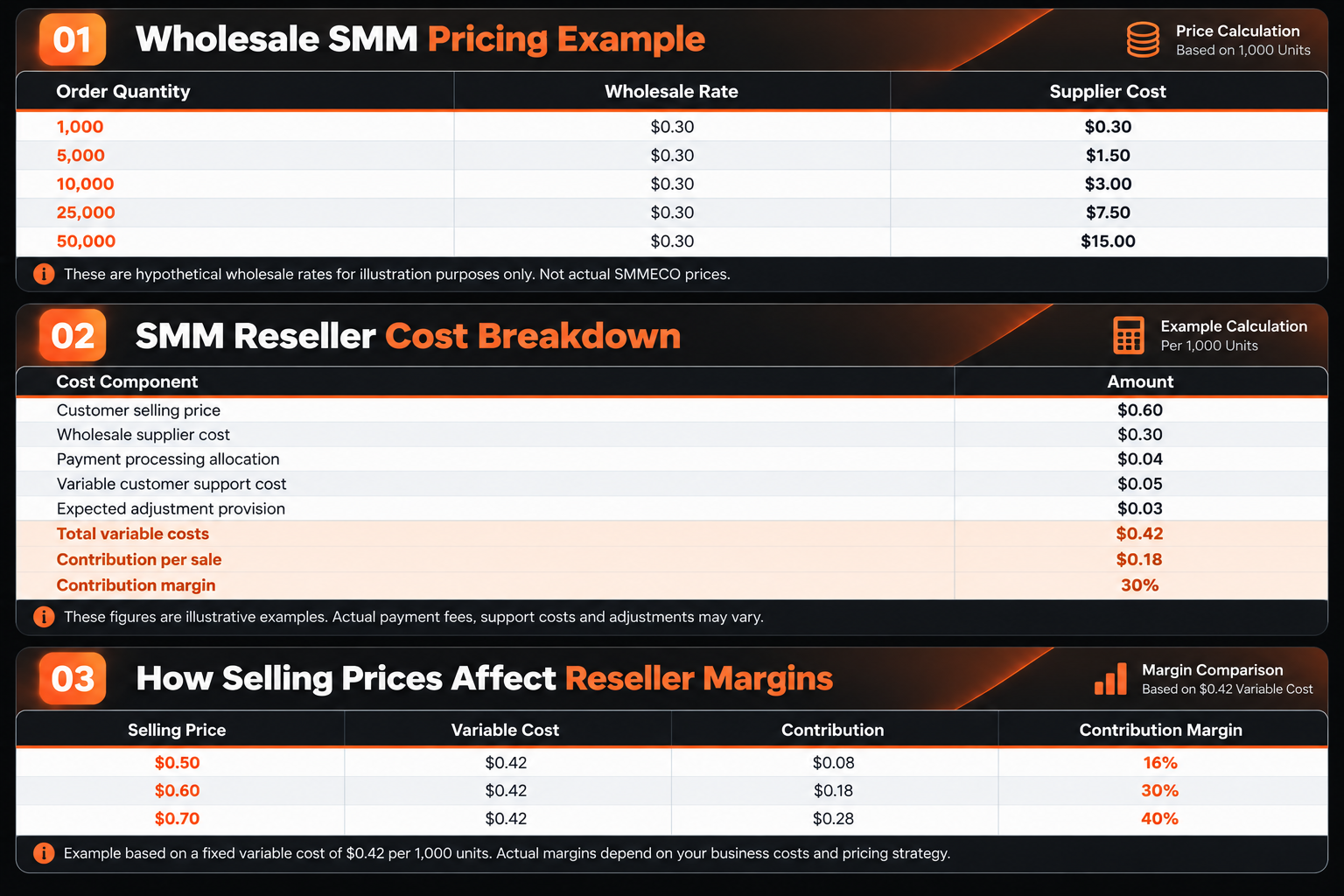
Consider the following hypothetical wholesale rate of $0.30 per 1,000 units:
All values are hypothetical examples, not live SMMECO prices or verified market quotations.
This calculation works when the supplier uses a consistent per-1,000 rate.
Some suppliers may offer quantity discounts or charge differently for particular service configurations.
Wholesale SMM Provider vs Reseller Panel
Before calculating profit margins, it is useful to understand the difference between a wholesale supplier and a reseller.
Wholesale SMM Provider
A wholesale provider generally supplies services to reseller businesses, agencies or other customers.
It may operate direct services, aggregate upstream sources or use a combination of models.
SMM Reseller Panel
A reseller panel offers services through its own website and manages the customer relationship.
The reseller may control:
- Customer-facing service names
- Selling prices
- Service categories
- Account registration
- Payment collection
- Customer support
- Order management
The upstream provider usually determines the supplier's service conditions and the corresponding wholesale charges.
A reseller must therefore manage the difference between supplier costs and customer revenue.
What Is an SMM Reseller Profit Margin?
An SMM reseller profit margin represents the percentage of revenue remaining after subtracting the relevant costs.
There are several ways to measure profitability, and they should not be confused.
Gross Profit
Gross profit is the difference between customer revenue and the direct supplier cost.
Gross Profit = Selling Price − Supplier Cost
For example:
- Selling price: $0.60
- Supplier cost: $0.30
Gross Profit = $0.30
The gross profit margin is:
Gross Profit Margin = (Gross Profit ÷ Selling Price) × 100
In this example:
$0.30 ÷ $0.60 × 100 = 50%
The reseller has a 50% gross margin before additional operating expenses.
Markup vs Profit Margin
Markup and profit margin are different calculations.
Markup = (Selling Price − Supplier Cost) ÷ Supplier Cost × 100
Gross Margin = (Selling Price − Supplier Cost) ÷ Selling Price × 100
In the example above, the markup is 100%, while the gross margin is 50%.
This distinction matters when resellers set selling prices.
Contribution Margin
Contribution margin subtracts additional variable expenses from revenue.
These may include payment fees, variable support costs and expected service adjustments.
Contribution margin provides a more realistic view of how much each sale contributes toward fixed expenses and eventual profit.
It is not the same as final net profit.
Wholesale SMM Panel Pricing: Example Cost Breakdown
Let's examine a hypothetical reseller transaction.
Assume the reseller sells a service for $0.60 per 1,000 units.
The supplier charges $0.30 for the same quantity.
However, the reseller also expects additional transaction-related expenses.
The figures are illustrative. Actual payment fees, support expenses and service adjustments depend on the business.
In this example, the gross margin is 50%, but the contribution margin is only 30%.
The $0.18 contribution must still cover fixed business expenses before the reseller earns net profit.
This demonstrates why supplier prices alone are insufficient for evaluating profitability.
How to Calculate the Minimum Profitable Selling Price
A reseller should determine the minimum acceptable selling price before publishing a service.
Start by estimating all relevant variable costs.
For example:
- Supplier cost: $0.30
- Transaction expenses: $0.04
- Variable support expenses: $0.05
- Expected adjustment provision: $0.03
Total Variable Cost = $0.42
If the reseller wants a contribution margin of 25%, use:
Required Selling Price = Total Variable Cost ÷ (1 − Target Margin)
Therefore:
$0.42 ÷ (1 − 0.25) = $0.56
The required selling price would be $0.56 for a 25% contribution margin under these assumptions.
This is not a guarantee of net profitability because fixed costs and taxes have not been deducted.
How Selling Prices Affect Reseller Margins
Using the same hypothetical variable cost of $0.42, consider three selling prices:
A relatively small change in selling price can significantly affect the amount retained.
However, raising prices does not guarantee higher total profit.
Customer demand, competing offers and the suitability of the service must also be considered.
Hidden Costs of Running an SMM Reseller Business
Supplier costs are only one component of operating a reseller panel.
A business should account for additional expenses when planning its pricing strategy.
1. Payment Processing Fees
Payment systems may charge transaction fees.
The effective cost can depend on the payment method, transaction value, currency conversion and other terms.
Small transactions can be particularly sensitive to fixed processing charges.
2. Customer Support Expenses
Customer support requires time and resources.
Resellers may need to investigate order statuses, explain service conditions, process support tickets or contact upstream suppliers.
These activities create operating costs even when a service is inexpensive.
3. Refunds and Partial Orders
Depending on supplier policies, some orders may be canceled or partially completed.
A reseller should understand how the supplier handles adjustments and how those changes affect customer balances.
Do not assume that every order can be canceled or refunded.
4. Refill-Related Expenses
Some services offer refill guarantees, while others provide no refill support.
A reseller should never advertise a refill guarantee that the supplier does not support.
If a business voluntarily covers an adjustment outside the supplier's guarantee, the cost may reduce its margin.
5. Hosting and Software
Running an SMM panel may involve website hosting, domain registration, software subscriptions, backups and technical maintenance.
These expenses should be included when calculating business profitability.
6. API Integration and Maintenance
Businesses using an SMM panel API may need to maintain supplier connections, synchronize catalogs and handle technical errors.
Automation can reduce manual work, but it does not eliminate maintenance costs.
7. Supplier Price Changes
Wholesale SMM service prices may change.
If a reseller's supplier increases rates but the reseller continues selling at the old price, the remaining margin may decrease.
Regular supplier price monitoring is therefore important.
How to Set Reseller Prices for SMM Services
A sustainable pricing strategy should balance customer demand, operating costs and the required margin.
Step 1: Identify the Wholesale Cost
Start with the actual supplier rate for the selected service.
Confirm whether the rate applies per 1,000 units or another billing unit.
Step 2: Estimate Variable Expenses
Consider payment processing charges, expected service-related adjustments and variable support costs.
Avoid assuming that these expenses are always zero.
Step 3: Establish a Margin Target
Choose a target based on your business requirements rather than relying on an unverified industry average.
A higher margin target may improve contribution per sale but can also influence demand.
Step 4: Calculate the Required Price
Use the total variable cost and target margin.
Required Price = Variable Cost ÷ (1 − Desired Contribution Margin)
Make sure the desired margin is expressed as a decimal.
For example, 30% becomes 0.30.
Step 5: Review Competitor Offers
Compare equivalent service specifications and policies.
A lower competitor price does not necessarily mean the competitor offers an identical product or cost structure.
Step 6: Monitor Supplier Rate Changes
Review the supplier catalog regularly.
If a service becomes unavailable or its cost changes substantially, reevaluate the reseller listing before accepting additional orders.
Step 7: Review Business Performance
Monitor actual expenses rather than relying entirely on initial estimates.
Historical financial results can help improve future pricing decisions.
Wholesale SMM Panel Pricing for High-Volume Resellers
High-volume reseller businesses may have different purchasing requirements from smaller operations.
As transaction volume grows, even minor differences in supplier cost can affect total expenses.
For example, consider a hypothetical business purchasing 100,000 units of an equivalent service.
At a wholesale rate of $0.30 per 1,000 units:
100,000 ÷ 1,000 × $0.30 = $30
At a rate of $0.27 per 1,000 units:
100,000 ÷ 1,000 × $0.27 = $27
The difference is $3 for that quantity.
Although small for one batch, cost differences may accumulate over repeated purchases.
However, the lower rate still needs to be compared with equivalent service conditions.
A high-volume reseller should consider the complete supplier relationship rather than chasing the lowest rate for every individual transaction.
Do Main Provider SMM Panels Offer Better Wholesale Prices?
A main provider SMM panel is commonly described as an upstream supplier of social media marketing services.
Some businesses use the term to suggest direct access to service sources.
However, "main provider" is not an official certification.
A provider may source some services directly and obtain others from upstream suppliers.
A direct sourcing relationship also does not automatically guarantee the lowest retail or wholesale price.
Wholesale pricing can depend on:
- Service specifications
- Purchasing agreements
- Order quantities
- Operating expenses
- Supplier relationships
- Available capacity
The practical approach is to compare documented service conditions and actual rates.
Avoid assuming that every company advertising itself as a main provider offers the same pricing advantages.
How SMM Panel APIs Help with Wholesale Pricing
An SMM panel API can support reseller pricing management when the supplier makes suitable functions available.
Depending on the provider, an API may allow resellers to retrieve service catalogs, check prices, submit orders and monitor order statuses.
For example, a reseller may periodically retrieve its supplier's current service rates.
Its internal system can then compare those rates with existing customer-facing prices.
When supplier rates change, the reseller can review the affected products.
Automatic Price Synchronization
Automatic synchronization can reduce repetitive catalog administration.
However, pricing updates should include safeguards.
A system should not blindly replace every selling price with the supplier's wholesale rate.
Doing so could remove the reseller's markup or create unprofitable listings.
Service ID Mapping
Different providers may assign different IDs to similar services.
When integrating multiple suppliers, maintain accurate service mappings.
Incorrect mappings can result in wrong service prices or order failures.
Monitoring Pricing Changes
A useful reseller workflow may track:
- Previous supplier rate
- Current supplier rate
- Percentage price change
- Current selling price
- Estimated contribution margin
- Services requiring review
This information helps businesses identify listings affected by supplier updates.
Single Supplier vs Multiple Suppliers: Which Pricing Model Works?
Some reseller businesses rely on one upstream SMM provider.
Others connect to multiple suppliers.
Single Supplier
Using one provider may simplify billing, service mapping, balance management and API integration.
However, reliance on one supplier creates concentration risk if important services become unavailable.
Multiple Suppliers
Multiple suppliers can provide additional sourcing flexibility.
A reseller may compare rates and service specifications across several providers.
However, this approach requires more administrative work, separate supplier balances and more complex API integrations.
The best structure depends on the business's requirements and its ability to manage the additional complexity.
A larger supplier network is not automatically more profitable.
Break-Even Analysis for SMM Resellers
Contribution margin helps determine how much revenue remains to cover fixed costs.
Consider a simplified example:
- Contribution per sale: $0.18
- Monthly fixed operating costs: $15
Break-Even Sales = Fixed Costs ÷ Contribution per Sale
Therefore:
$15 ÷ $0.18 = 83.33
The business would need at least 84 sales of the example service to cover those fixed costs, assuming the contribution per sale remains unchanged.
This calculation excludes taxes, other expenses and any variation in service mix.
Actual reseller businesses may offer many services with different margins.
In that case, a weighted average contribution margin can provide a more useful break-even estimate.
Common Wholesale SMM Pricing Mistakes
Confusing Markup with Margin
A 50% markup does not mean a 50% gross profit margin.
Resellers should calculate each metric using the correct formula.
Copying Supplier Prices Directly
Selling services at wholesale cost leaves no gross profit to cover additional business expenses.
Ignoring Payment Fees
Small fixed transaction fees can significantly affect low-priced orders.
Assuming Refill Services Have No Cost
Refill guarantees may be limited, and any additional adjustment supported by the reseller may create an expense.
Failing to Monitor Provider Pricing
Supplier cost increases can reduce margins when reseller prices remain unchanged.
Comparing Different Services as Identical
Services with similar names may have different quantities, conditions, account requirements or limitations.
Treating Projected Margins as Guaranteed Profit
Forecasts are estimates.
Actual profitability depends on real transactions, customer demand and business expenses.
Ignoring Social Media Platform Policies
Some third-party services designed to artificially increase engagement can violate platform policies.
For example, YouTube's fake engagement policy restricts artificial increases in views, likes and subscribers.
Resellers should consider platform rules and potential account risks when evaluating service categories.
How to Choose a Wholesale SMM Panel Provider
Before selecting a wholesale provider, evaluate its operational capabilities and documented service conditions.
An appropriate supplier comparison should consider:
Pricing transparency: Are service rates and billing units clearly explained?
Service catalog: Does the provider offer relevant categories with understandable descriptions?
Order management: Can customers track submitted orders and understand their status?
API capabilities: Does the provider support the functions required by the reseller's software?
Refill and cancellation policies: Are the relevant service conditions clearly documented?
Payment terms: Are deposit requirements, fees and balance policies understandable?
Support procedures: Is there a clear process for resolving order-related questions?
Platform compliance: Have the risks and rules associated with the services been evaluated?
A structured comparison can help identify a provider that matches the reseller's actual requirements.
Explore Affordable SMM Services with SMMECO
SMMECO is a global SMM panel platform offering access to social media marketing service categories for platforms including Instagram, TikTok, YouTube and Telegram.
Businesses researching wholesale SMM panel pricing can explore the available catalog and review individual service conditions.
Whether you are operating a reseller panel, managing agency orders or comparing SMM service costs, understanding provider pricing is an important part of the purchasing process.
Visit SMMECO — Global SMM Panel to explore available service options.
Always verify current prices, available features and service conditions before placing an order.
Frequently Asked Questions
What is wholesale SMM panel pricing?
Wholesale SMM panel pricing refers to the supplier rates offered for social media marketing services, commonly to reseller businesses or agencies. Prices may be calculated per 1,000 units or using other billing structures.
How much profit can an SMM reseller make?
There is no guaranteed profit margin. Earnings depend on selling prices, supplier costs, transaction fees, customer demand, support expenses and other business costs.
How do I calculate my SMM reseller profit margin?
For gross margin, subtract the supplier cost from the selling price, divide the result by the selling price and multiply by 100. For a more realistic contribution margin, subtract additional variable costs as well.
What is the difference between markup and profit margin?
Markup compares the gross profit with the supplier cost, while gross margin compares the gross profit with the selling price. They use different denominators and therefore produce different percentages.
Is a wholesale SMM panel cheaper than a reseller panel?
Not necessarily. Wholesale providers may offer competitive rates, but pricing depends on service specifications, supplier agreements and business expenses. Compare equivalent services rather than relying on the wholesale label.
What is the cheapest wholesale SMM panel?
There is no universally cheapest supplier across every service. Rates can change, and services with similar names may have different specifications and conditions.
Can I automate wholesale SMM pricing with an API?
Some SMM providers offer APIs that allow businesses to retrieve current service rates and catalog information. Automated reseller pricing also requires appropriate validation and margin controls.
How do supplier price changes affect reseller profits?
If a supplier raises its wholesale rate while the reseller maintains the same selling price, the reseller's margin generally decreases, assuming other costs remain unchanged.
Should an SMM reseller use multiple providers?
Using multiple providers may offer sourcing flexibility, but it adds operational complexity. The choice depends on business requirements, available technical resources and supplier conditions.
Final Thoughts
Understanding wholesale SMM panel pricing is an important part of building and operating an SMM reseller business.
The lowest advertised supplier price does not necessarily produce the best financial result.
Resellers need to consider service costs, payment fees, support requirements, supplier changes and other operating expenses.
By calculating gross margins, contribution margins and break-even points, businesses can make better-informed pricing decisions.
For reseller businesses in 2026, a sustainable pricing strategy involves more than adding a markup to a wholesale rate.
The goal is to understand your true costs, choose suitable suppliers and set prices that support the long-term operation of your business.