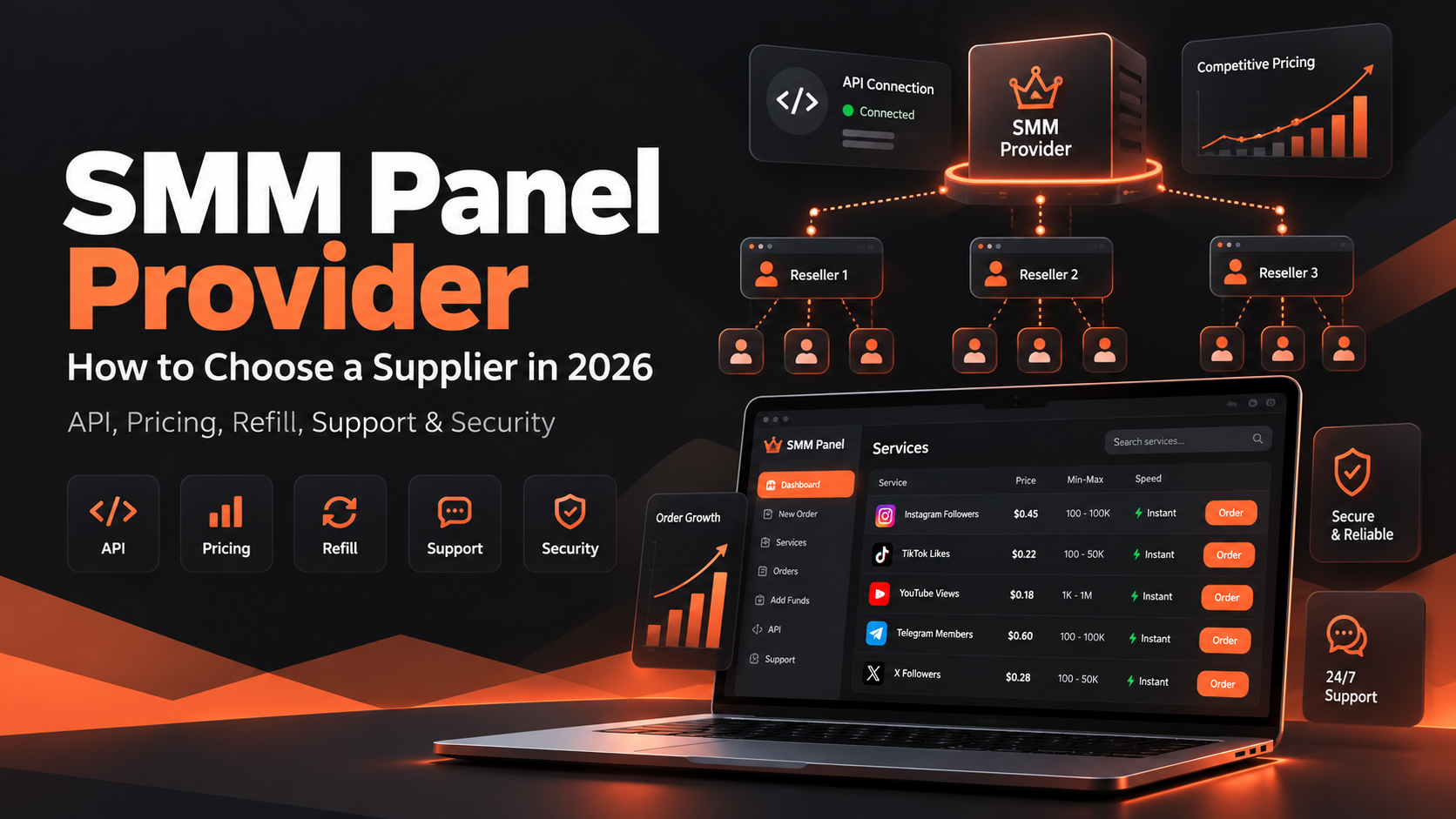
How to Choose an SMM Panel Provider for Resellers in 2026
Choosing the right SMM panel provider is one of the most important decisions for anyone operating an SMM reseller business.
Whether you manage your own panel, handle customer orders or operate a social media marketing agency, your supplier affects pricing, service availability, order management and customer support.
With so many providers advertising cheap SMM services, wholesale prices and automated API integration, finding a suitable supplier requires more than comparing advertised rates.
A low price may look attractive, but unclear refill conditions, inconsistent service catalogs and limited API functionality can create additional operating costs.
In this guide, we'll explore how to evaluate SMM panel providers, compare supplier costs, understand API requirements and select services that match your business needs.
What Is an SMM Panel Provider?
An SMM panel provider is a platform that supplies social media marketing services to customers, agencies or other reseller panels.
Depending on its business model, a provider may offer services for platforms such as Instagram, TikTok, YouTube and Telegram.
Some suppliers operate their own service infrastructure, while others aggregate services from multiple upstream providers.
For reseller businesses, an SMM provider often acts as the supplier behind their customer-facing website.
Quick Answer: The best way to choose an SMM panel provider for resellers is to compare service specifications, pricing, API reliability, order tracking, refill policies, customer support, payment terms and platform-related risks. A low price alone does not establish that a supplier is suitable.
Why Choosing the Right SMM Provider Matters
Resellers depend on their suppliers to process orders under the service conditions advertised to customers.
If an upstream service becomes unavailable, changes its pricing or experiences delays, the reseller may need to handle additional customer questions and operational issues.
Choosing a provider therefore affects more than the cost of an individual order.
It can influence:
- Business operating expenses
- Product catalog management
- Customer satisfaction
- Order monitoring and reporting
- Technical integration requirements
- Support workload
- Reseller profit margins
A provider with the lowest advertised price may not be the most practical option if it lacks the features required by your business.
9 Things to Check Before Choosing an SMM Panel Provider
1. Service Catalog and Availability
A suitable provider should offer services relevant to your customers.
Rather than looking only at the total number of services, review the individual categories and service descriptions.
Important details include:
- Service ID and name
- Minimum order quantity
- Maximum order quantity
- Pricing structure
- Supported links or account types
- Refill availability
- Cancellation conditions
- Additional service limitations
A catalog with thousands of listings is not automatically better than a smaller, clearly organized catalog.
For reseller businesses, consistent service information can reduce mistakes when creating customer-facing product listings.
2. Transparent and Competitive Pricing
Price is an important consideration when evaluating a cheap SMM panel provider.
However, service prices should be compared using equivalent specifications.
For example, two services may display different prices per 1,000 units but offer different order limits, conditions or guarantees.
Before selecting a supplier, determine:
- Whether pricing is displayed per 1,000 units or another unit
- Whether rates change by order quantity
- Whether additional transaction fees apply
- Whether prices can change without advance notice
- Whether the service conditions justify the price difference
Wholesale pricing can be useful for resellers, but the term "wholesale" does not guarantee the lowest available rate.
3. SMM Panel API Integration
For businesses processing many orders, API availability can be an important operational requirement.
An SMM panel API allows supported tasks to be performed programmatically.
Depending on the provider, an API may support:
- Retrieving the service catalog
- Checking current prices
- Submitting orders
- Retrieving order statuses
- Checking account balances
- Requesting eligible refills
- Requesting supported cancellations
An API can reduce manual order entry and help resellers manage their workflows.
However, providers do not all support the same functions.
Before integrating an SMM provider API, review its documentation and confirm which operations are actually available.
4. Order Tracking and Status Management
Order tracking becomes increasingly important as a reseller business grows.
A provider should offer understandable status information so that users can monitor their orders.
Common statuses may include:
- Pending
- In progress
- Completed
- Partial
- Canceled
Status names and behavior vary between platforms.
For API-based businesses, check whether the provider allows multiple order statuses to be retrieved in one request.
Also verify how the system reports quantities, remaining amounts and partial completion.
These details can affect customer notifications and internal reporting.
5. Refill and Cancellation Policies
One of the most common mistakes when selecting an SMM provider is assuming that every service includes a refill guarantee.
In practice, service conditions differ.
Some products may have a specific refill period, while others offer no refill support.
Cancellation can also be limited by order status or service type.
Before choosing a supplier, review:
- Which services are eligible for refill
- The applicable guarantee period
- The conditions that invalidate refill eligibility
- Whether cancellation is supported
- How partial completion is handled
- Whether refunds are credited to the account balance
These policies should be clearly communicated to your customers.
A service without a refill guarantee should not be advertised as guaranteed.
6. Customer Support and Issue Resolution
Customer support is especially important for reseller panels because problems may involve several systems.
For example, a customer may report an order issue to the reseller, who then needs to contact the upstream supplier.
A useful provider should have clear procedures for investigating orders and responding to support requests.
Evaluate the available support channels, published operating hours and issue-resolution process.
Avoid making business promises based on response times that the provider has not committed to.
7. API Security and Account Protection
When connecting your reseller business to an upstream SMM panel, security should be part of the evaluation.
API credentials may permit account access or the submission of paid orders.
Resellers should:
- Keep API keys on a secure server
- Avoid exposing credentials in public JavaScript
- Use HTTPS connections
- Restrict internal access to sensitive credentials
- Rotate compromised keys
- Avoid logging secrets in plain text
- Validate API responses before processing them
Technical integration should also account for failed network requests.
Important: If an order request times out, do not automatically assume the order failed. Check whether the supplier created it before submitting another request. Otherwise, duplicate orders may occur.
Reliable automation is not only about submitting orders quickly. It is also about handling failures safely.
8. Payment Methods and Balance Management
Different providers support different payment methods.
Some operate through cryptocurrency payment systems, while others offer additional deposit options.
Before adding funds, review the available methods and their requirements.
Important questions include:
- What is the minimum deposit?
- Are deposit fees charged?
- How is account balance displayed?
- Can unused balance be withdrawn?
- How are partial refunds processed?
- Are payments confirmed automatically or manually?
Payment terms can affect cash flow, especially for businesses operating with prepaid supplier balances.
Never assume that a provider balance can be withdrawn unless its policies explicitly allow it.
9. Platform Policies and Business Risks
Not all social media marketing services carry the same risks.
Some third-party engagement services may violate the rules of the social media platforms on which they operate.
For example, YouTube's fake engagement policy prohibits artificially increasing metrics such as views, likes and subscribers.
Such activities may lead to removed engagement, enforcement actions or account restrictions.
Before selecting any service, review the relevant platform's rules and consider whether the service is appropriate for the intended use.
A supplier claiming that its services are completely risk-free should be evaluated carefully.
How to Compare SMM Panel Providers Using a Scorecard
Instead of choosing a provider based solely on advertised prices, use a structured evaluation framework.
The following weighted scorecard is a suggested starting point for reseller businesses.
Rate each provider from 0 to 5 for every criterion.
Calculate the weighted score using:
Weighted Score = Sum of (Criterion Weight × Rating ÷ 5)
For example, a provider receiving 4 out of 5 for API capabilities earns 16 of the 20 available points in that category.
The final score can help organize your comparison, but it is not a guarantee of performance or safety.
Businesses should adjust the weights according to their operational needs.
How to Calculate SMM Reseller Profit Margins
Choosing an affordable supplier is only one part of running a profitable reseller business.
You also need to understand the difference between supplier cost, selling price and operating expenses.
Consider this hypothetical example:
- Customer selling price: $1.00
- Supplier cost: $0.60
- Estimated transaction fees: $0.05
- Allocated support and operating costs: $0.10
The amount remaining is:
$1.00 − $0.60 − $0.05 − $0.10 = $0.25
The illustrative contribution margin is:
$0.25 ÷ $1.00 × 100 = 25%
This calculation excludes taxes and any additional expenses not included in the example.
It shows why selecting the cheapest SMM provider does not automatically produce the highest business profit.
A reseller with unexpected refund costs, payment fees or support expenses may retain less revenue than initially expected.
Should Resellers Use One Provider or Multiple Providers?
Both approaches have advantages and limitations.
Using One SMM Panel Provider
Working with one supplier can simplify:
- Account balance management
- API integration
- Service catalog updates
- Support communication
- Internal order administration
However, dependence on a single supplier may also create operational concentration risk.
If important services become unavailable, the reseller may have fewer alternatives.
Using Multiple SMM Providers
A multi-provider setup can offer additional flexibility.
A reseller may select different suppliers for different service categories, prices or operational requirements.
However, managing several suppliers adds complexity.
It may require:
- Multiple API connections
- Different service ID mappings
- Separate balances
- Supplier-specific order rules
- More advanced error handling
- Additional reconciliation work
For a new reseller business, operational simplicity may be more valuable than maintaining the largest possible number of suppliers.
As order volumes increase, a more sophisticated multi-provider structure may become appropriate.
Common Mistakes SMM Resellers Should Avoid
Selecting a Provider Only Because It Is Cheap
Low rates are useful, but service conditions, policies and operational costs also matter.
Ignoring API Documentation
An API advertised as available may not support every function your business requires.
Always evaluate documentation before building a dependent workflow.
Assuming Every Service Is Guaranteed
Refill conditions can vary. A reseller should never promise a guarantee that is not included in the actual service terms.
Submitting Duplicate Orders
Repeated requests after connection errors can cause duplicate submissions.
Check existing order records and supplier responses before retrying uncertain transactions.
Making Unsupported Customer Promises
Avoid guaranteeing exact delivery times, permanent results or complete account safety when those claims cannot be substantiated.
Failing to Monitor Service Changes
Supplier prices, service IDs and product availability can change.
Maintain a process for reviewing catalog changes and updating your own listings.
Ignoring Account and Platform Security
Protect API credentials, review payment terms and assess social media platform policies before offering services to customers.
A Practical Supplier Evaluation Workflow
If you are evaluating a new provider, follow these steps.
Step 1: Identify the social media platforms and services your customers actually need.
Step 2: Compare the relevant suppliers using equivalent service specifications.
Step 3: Review pricing, guarantees, refund rules and payment requirements.
Step 4: Read the API documentation and identify missing functions.
Step 5: Check order tracking, error handling and available support procedures.
Step 6: Calculate realistic reseller costs using your expected order volume and operating expenses.
Step 7: Review applicable platform rules and avoid services that introduce unacceptable account or compliance risks.
Step 8: Reassess the provider periodically as pricing, features and conditions change.
A consistent process helps reduce avoidable operational surprises.
Explore SMM Services with SMMECO
SMMECO is a global SMM panel platform where users can explore social media marketing services for platforms including Instagram, TikTok, YouTube and Telegram.
Customers and reseller businesses should compare the currently available services, pricing and individual conditions before placing orders.
When evaluating any SMM provider, consider its operational features alongside its service catalog rather than relying on promotional claims alone.
Visit SMMECO — Global SMM Panel to explore available service options.
Frequently Asked Questions
What is the best SMM panel provider for resellers?
There is no single provider that is best for every reseller. The most suitable option depends on service availability, pricing, API requirements, support, payment terms and acceptable business risks.
How do I find a cheap SMM panel provider?
Compare equivalent services, review provider conditions and calculate total operating costs. The cheapest advertised rate may not represent the lowest overall cost for your business.
Do SMM panel providers offer APIs?
Some providers offer APIs for service catalogs, order submission, order status tracking, balance checks and other supported tasks. Specific features depend on the provider.
Can I connect multiple providers to one SMM panel?
Some reseller panel systems support multiple supplier integrations. Compatibility depends on the software, API formats and configuration of the reseller platform.
What is the difference between an SMM panel provider and a reseller?
A provider supplies services directly or through upstream sources. A reseller purchases or sources services and offers them to customers through its own platform. A business may operate in both roles.
How much profit can an SMM reseller make?
Profit depends on supplier costs, selling prices, order volume, refunds, fees and business expenses. There is no guaranteed profit margin, so resellers should calculate their actual costs rather than relying on advertised examples.
Is a main provider SMM panel always better?
No. The term "main provider" does not guarantee lower pricing, stronger API features or better service performance. Each provider should be evaluated using documented capabilities and relevant operating conditions.
Final Thoughts
Finding a suitable SMM panel provider for resellers involves more than selecting the cheapest available supplier.
Service catalog quality, API integration, order management, pricing transparency, support procedures and platform risks all play important roles.
For reseller businesses, building a sustainable operation requires clear information, responsible service selection and realistic cost calculations.
Use a structured comparison process to identify providers whose documented capabilities match your business requirements.
A good provider decision is based on the total value of its services and operations—not simply the lowest advertised price.