How to Compare SMM Panel Providers Before Ordering in 2026
Choosing an SMM panel provider can be difficult when hundreds of websites advertise cheap services, competitive prices, extensive catalogs and reseller-friendly features.
At first glance, many SMM panels look similar. They may offer services for Instagram, TikTok, YouTube and Telegram, with different prices and delivery conditions.
However, the lowest advertised price does not always represent the best value.
Service restrictions, payment terms, refill eligibility, order management and platform-related risks can vary significantly between providers.
Whether you are an individual customer, a marketing agency or an SMM reseller, comparing these details before ordering can help you make a more informed decision.
This guide explains how to compare SMM panel providers in 2026, what to check before depositing funds and which warning signs deserve particular attention.
What Should You Compare When Choosing an SMM Panel?
An SMM panel is an online platform that provides access to social media marketing services.
Depending on the provider, its catalog may include followers, likes, views and other engagement-related services for different social media platforms.
Some panels source services directly, while others use upstream providers or combine multiple suppliers.
Quick Answer: To compare SMM panel providers effectively, evaluate their service descriptions, pricing, refill and cancellation policies, payment conditions, order tracking, support quality, account security and compliance with social media platform rules.
A good comparison focuses on verifiable information rather than claims such as "best," "cheapest" or "100% guaranteed."
Why Comparing SMM Panel Providers Matters
Two SMM panels may advertise similar services while offering very different purchasing conditions.
For example, one service may include limited refill eligibility, while another does not offer refills at all.
A provider may support automated order tracking through an API, while another requires manual checks.
Even when prices are similar, these differences can affect convenience and business costs.
A systematic comparison helps customers understand what they are buying, which conditions apply and what happens when an order encounters a problem.
For reseller businesses, choosing unsuitable suppliers can also create additional customer support work and operational expenses.
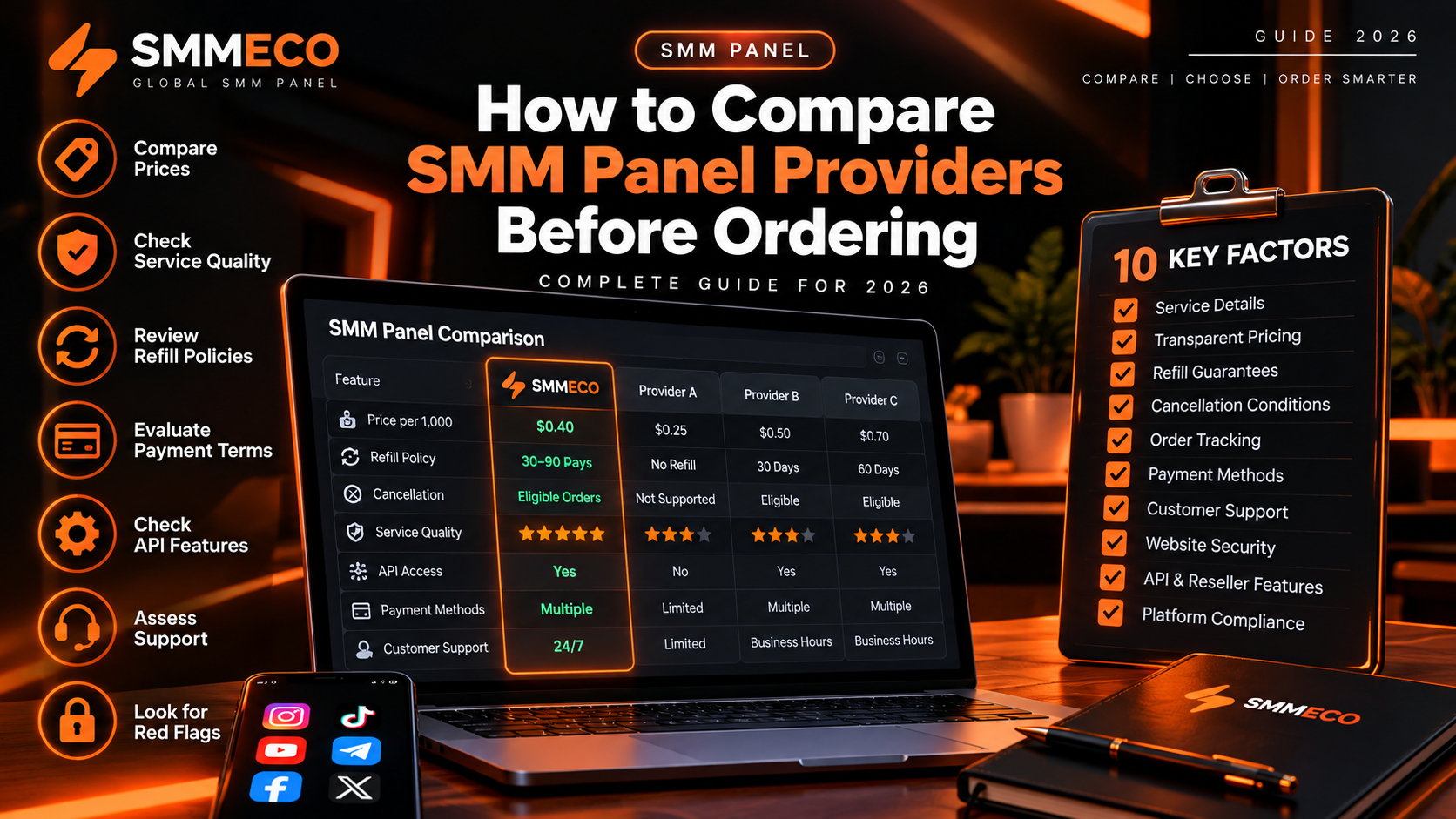
10 Things to Check Before Choosing an SMM Panel Provider
1. Service Descriptions and Availability
Start by reviewing the provider's actual service catalog.
A service name alone may not provide enough information to make a purchasing decision.
Look for clearly documented details such as the minimum quantity, maximum quantity, supported content type, account requirements and service restrictions.
Compare services with equivalent specifications.
A provider offering thousands of listed services is not automatically better than one with a smaller but clearly organized catalog.
Also check whether the relevant service is currently available rather than relying on an old promotional page.
2. Transparent SMM Panel Pricing
When searching for a cheap SMM panel, price is naturally an important factor.
Many SMM panels display rates per 1,000 units, although some use alternative pricing structures.
For quantity-based pricing, the calculation is:
Order Cost = (Quantity ÷ 1,000) × Rate per 1,000
For example, if a hypothetical service costs $0.40 per 1,000 units, an order of 5,000 units would cost:
5,000 ÷ 1,000 × $0.40 = $2.00
However, this calculation only measures the advertised service charge.
Depending on the supplier, payment fees, account funding conditions and service-related adjustments may also matter.
Always check whether two advertised prices refer to services with equivalent terms.
3. Refill Guarantees
Refill policies explain whether eligible drops in previously delivered quantities may be replaced.
Some providers offer limited refill periods, while others list services without refill support.
Before ordering, identify:
- Whether the service includes refill eligibility.
- The duration and starting point of the guarantee.
- Whether the account must remain public.
- Whether username or link changes affect eligibility.
- Whether the original start count matters.
- How a refill request is submitted.
A refill guarantee should not be interpreted as a promise of permanent results.
4. Cancellation and Refund Conditions
Not every SMM panel order can be canceled.
Some providers support cancellation for certain pending orders, while others may restrict cancellation once an order enters processing.
Review the service's cancellation conditions and refund procedures.
Important questions include whether cancellation is available, what happens to undelivered quantities and whether approved adjustments are credited to the panel balance.
A Cancel button does not necessarily mean a cancellation request will be approved.
The final decision depends on the applicable service terms and order state.
5. Order Tracking and Status Transparency
A practical SMM panel should provide understandable order information.
Common order statuses may include Pending, In Progress, Processing, Completed, Partial and Canceled.
Status definitions can vary between providers.
For example, a Partial status generally indicates that only part of the requested quantity was fulfilled.
Customers should check whether the provider explains how the undelivered portion is calculated and handled.
Reseller businesses may also benefit from downloadable records or supported API-based order tracking.
6. Payment Methods and Account Balance Policies
Review payment conditions before depositing funds.
Different panels may support cryptocurrency payments, card payments or other methods.
However, availability depends on the provider and its current payment integrations.
Check the minimum deposit, applicable transaction fees, refund procedures and whether unused balance can be withdrawn.
Some panels use prepaid balances that can only be spent on services within the platform.
Avoid assuming that internal panel credit functions like a withdrawable bank balance.
7. Customer Support and Communication
Customer support matters when an order is delayed, partially completed or requires investigation.
Look for clear contact information and understandable support procedures.
A provider should explain how customers can submit order-related questions and what information is required.
Support availability should be evaluated using actual published hours, not assumptions.
A panel promising instant support is not necessarily more useful than one providing realistic response expectations and clear processes.
8. Website and Account Security
Account security should be part of every provider comparison.
Before creating an account or adding funds, check that the website uses HTTPS and follows reasonable security practices.
Avoid sharing unnecessary social media login credentials, verification codes or private API keys.
A legitimate ordering process should not require customers to disclose sensitive information unrelated to the selected service.
For resellers, supplier API keys should be stored securely on the server rather than exposed in public frontend code.
9. API and Reseller Features
For individual customers, API support may not be necessary.
For agencies and resellers, it can be an important operational requirement.
An SMM panel API may provide programmatic access to service catalogs, order submissions, order statuses and account balances.
Some providers also support refill or cancellation requests through their APIs.
However, API availability does not prove that a company is a direct service provider.
Always review the documentation before planning an automated integration.
10. Platform Policies and Account Risks
Some third-party engagement services may violate the rules of the social platforms on which they operate.
For example, YouTube prohibits artificially increasing views, likes and other engagement metrics.
TikTok also prohibits trading or promoting services designed to artificially increase engagement.
These restrictions matter even when a third-party provider describes its services as safe or guaranteed.
Before ordering, review the relevant platform's rules and consider whether legitimate advertising, creator partnerships or organic marketing would better suit your goals.
SMM Panel Provider Comparison Checklist
Use the following table to organize the information you should review before making a purchase.
How to use this checklist: Compare each provider using publicly available documentation and actual account features. Treat missing information as something to investigate rather than assuming favorable conditions.
No single checklist can guarantee supplier performance, but a structured review can reveal important differences before payment.
Cheap SMM Panel vs Main Provider SMM Panel
Two common search terms are cheap SMM panel and main provider SMM panel.
Although they are often used together, they describe different characteristics.
What Is a Cheap SMM Panel?
A cheap SMM panel emphasizes relatively low service prices.
Its products may come from direct sources, upstream suppliers or other reseller businesses.
The word "cheap" describes pricing, not necessarily reliability or the origin of a service.
What Is a Main Provider SMM Panel?
A main provider generally refers to an upstream supplier serving customers or other SMM panels.
However, main provider is not an official industry certification.
A company may source some services directly while reselling others.
Which Is Better?
Neither label alone establishes which provider is more suitable.
A cheap provider may have acceptable conditions for certain products, while an upstream supplier may offer better operational features for resellers.
The practical choice depends on documented service terms, pricing, operational needs and acceptable risks.
How to Compare SMM Panel Prices Without Misleading Yourself
Comparing prices becomes difficult when providers use different service specifications.
Consider three hypothetical services:
Provider A has the lowest advertised price.
However, the other providers offer different conditions.
This does not automatically make Provider B or Provider C better. Their guarantees must be evaluated, and no listed feature removes platform-policy risks.
The correct comparison depends on the requirements that actually matter to the customer.
For example, a customer who requires cancellation eligibility should not compare prices without checking whether that feature is supported.
A reseller evaluating ongoing supplier costs should also consider payment fees and potential operational expenses.
How to Identify Warning Signs Before Ordering
Not all potential issues can be identified from a website, but some warning signs justify additional investigation.
Unrealistic Guarantees
Be cautious of claims promising permanent engagement, guaranteed account safety or risk-free use of all services.
Such guarantees may be impossible to substantiate.
Unclear Refund Conditions
A provider that does not explain what happens when an order fails may create unnecessary uncertainty.
Read payment and service terms before depositing money.
Missing Contact Information
Limited support options can make it difficult to resolve order-related problems.
Check whether there is a practical way to communicate with the service provider.
Requests for Sensitive Credentials
Do not provide social media passwords, two-factor authentication codes or supplier API keys unless there is a clear and legitimate reason—and avoid services that unnecessarily demand them.
Unverifiable Provider Claims
Terms such as "original provider," "number one" or "lowest prices worldwide" should be treated as marketing claims unless supported by appropriate evidence.
Misleading Performance Claims
Purchased followers, views or likes do not automatically translate into genuine customer interest, sales or organic reach.
Compare claims with the intended marketing outcome.
Should You Place a Small Order Before Making a Large Deposit?
Some buyers use a limited trial purchase to evaluate an unfamiliar provider.
If the service is lawful, platform-compliant and appropriate for the intended use, a small initial transaction may help assess certain operational details.
However, a small order cannot prove how a supplier will perform under every condition or at higher volumes.
Before committing significant funds, evaluate the following:
Payment confirmation: Does the account balance reflect the transaction accurately?
Order records: Can you retrieve the order details?
Status reporting: Are status changes understandable?
Support process: Is there a clear procedure for raising questions?
Service conditions: Do the actual terms match the published description?
Refund handling: Are adjustments handled according to the stated rules?
Avoid purchasing artificial engagement merely to test a provider. Such purchases may violate the relevant social media platform's rules.
The goal is to validate legitimate business processes, not to assume that a successful sample transaction proves long-term reliability.
Comparing SMM Panels for Personal Use vs Reselling
The best comparison criteria depend on the customer's purpose.
Individual Customers
Individual users may prioritize understandable service descriptions, payment transparency, account protection and customer support.
They should also consider whether the service aligns with the relevant platform's rules.
Marketing Agencies
Agencies may need stronger recordkeeping, clear order conditions and procedures for managing client questions.
For agencies, explaining risks and avoiding unsupported performance guarantees are especially important.
SMM Resellers
Resellers may require API access, supplier service mapping, order tracking and consistent cost information.
An inexpensive service can become difficult to manage when its policies or technical requirements are unclear.
For a reseller, operational complexity may matter just as much as the advertised supplier rate.
How to Evaluate SMM Providers for Long-Term Use
A provider suitable for one transaction may not remain the best option indefinitely.
Service catalogs, prices, available features and upstream relationships can change.
For recurring business use, periodically review the provider's current documentation.
Check whether important service IDs have changed, whether prices remain suitable and whether support conditions are still consistent with your requirements.
Maintain accurate records of supplier costs and order adjustments.
Do not rely only on old screenshots or promotional information when making new purchasing decisions.
Regular reviews help ensure that your provider choices remain based on current conditions.
What Questions Should You Ask an SMM Panel Provider?
Before purchasing from an unfamiliar platform, consider asking:
About services: What are the minimum quantities, account requirements and restrictions?
About guarantees: Does this exact service include refill support, and when does the guarantee expire?
About cancellations: Under what conditions can an order be canceled?
About payments: Are unused deposits withdrawable, and how are adjustments credited?
About support: How are delayed or partially completed orders investigated?
About API access: Which operations are supported, and where can the documentation be reviewed?
Clear answers to these questions can reduce misunderstandings before an order is placed.
If important conditions remain unclear, it may be better to continue researching rather than making an immediate purchase.
Explore Available SMM Services with SMMECO
SMMECO is a global SMM panel platform offering access to social media marketing service categories for Instagram, TikTok, YouTube and Telegram.
Users researching affordable SMM services can explore the catalog and review the available service conditions.
Before ordering, compare the selected product's pricing, requirements and applicable guarantees.
Resellers and agencies should also review operational features and determine whether the platform meets their business needs.
Visit SMMECO — Global SMM Panel to explore available services.
Always verify the latest service details and relevant platform policies before making a purchasing decision.
Frequently Asked Questions
How do I compare SMM panel providers?
Compare service descriptions, prices, order restrictions, refill eligibility, cancellation policies, payments, security, support and platform-related risks. Use the same criteria for each provider.
What is the best SMM panel provider in 2026?
There is no universally best provider. The most suitable platform depends on the customer's requirements, actual service conditions, pricing, operational features and acceptable risks.
Is the cheapest SMM panel always the best option?
No. A lower advertised price may come with different service specifications, refund conditions or operational limitations. Compare total costs and documented terms.
What is a reliable SMM panel?
A reliable SMM panel should provide accurate service information, transparent payment and refund terms, understandable order records, reasonable account security and a clear support process. Reliability cannot be guaranteed solely by a provider's marketing claims.
What is the difference between a main provider and a reseller panel?
A main provider is generally described as an upstream supplier, while a reseller usually sources services from other providers. A company may perform both roles for different services.
Should I choose an SMM panel with a refill guarantee?
Refill conditions can be relevant when comparing services, but they do not guarantee permanent results. Check the selected service's eligibility rules and the platform-policy risks involved.
Can I cancel an SMM panel order?
Some services allow eligible cancellations, but cancellation is not universally available. Check the provider's terms and order status before submitting a request.
Do all SMM panel providers offer API integration?
No. Some providers offer documented API functions for order management and catalog access, while others have limited or no API features.
Can an SMM panel guarantee that my account will never be restricted?
No. Third-party engagement services can involve platform-policy and account risks. No provider can guarantee that all services are risk-free.
What should I check before depositing money into an SMM panel?
Review payment methods, minimum deposit requirements, transaction fees, refund procedures, account balance restrictions and available customer support channels.
Final Thoughts
Knowing how to compare SMM panel providers before ordering helps customers evaluate more than promotional claims and advertised prices.
Service transparency, payment conditions, refill eligibility, cancellation policies, order management, security and platform compliance all matter.
For agencies and resellers, technical capabilities and operating costs add further considerations.
The most practical approach is to compare equivalent services, verify important conditions and understand the risks before committing funds.
Choose an SMM panel provider based on documented features and suitability—not simply the lowest advertised price.